SpaceX and other companies want to put millions of satellites into space. ͏ ͏ ͏ ͏ ͏ ͏ ͏ ͏ ͏ ͏ ͏ ͏ ͏ ͏ ͏ ͏ ͏ ͏ ͏ ͏ ͏ ͏ ͏ ͏ ͏ ͏ ͏ ͏ ͏ ͏ ͏ ͏ ͏ ͏ ͏ ͏ ͏ ͏ ͏ ͏ ͏ ͏ ͏ ͏ ͏ ͏ ͏ ͏ ͏ ͏ ͏ ͏ ͏ ͏ ͏ ͏ ͏ ͏ ͏ ͏ ͏ ͏ ͏ ͏ ͏ ͏ ͏ ͏ ͏ ͏ ͏ ͏ ͏ ͏ ͏ ͏ ͏ ͏ ͏ ͏ ͏ ͏ ͏ ͏ ͏ ͏ ͏ ͏ ͏ ͏ ͏ ͏ ͏ ͏ ͏ ͏ ͏ ͏ ͏ ͏ ͏ ͏ ͏ ͏ ͏ ͏ ͏ ͏ ͏ ͏ ͏ ͏ ͏ ͏ ͏ ͏ ͏ ͏ ͏ ͏ ͏ ͏ ͏ ͏ ͏ ͏ ͏ ͏ ͏ ͏ ͏ ͏ ͏ ͏ ͏ ͏ ͏ ͏ ͏ ͏ ͏ ͏ ͏ ͏ ͏ ͏ ͏ ͏ ͏ ͏
August 18, 2026—SpaceX and other companies want to put millions of satellites into orbit around Earth. Plus, what makes narwhal tusks grow straight, and climate change makes people feel powerless.
—Andrea Gawrylewski
Chief Newsletter Editor
|
|
A narwhal’s tusk. Mads Peter Heide-Jørgensen
|
|
How do narwhal tusks grow so straight yet spiraled? Scientists used advanced imaging technology to look at their tusks in unprecedented detail and discovered a kind of double helix structure. | 2 min read
Scientists whose papers are cited in a Heritage Foundation report on women in sports say the conservative think tank misrepresented their research. | 4 min read
Nearly four in 10 Americans have lived through an extreme weather event in the past year, and of these, 38 percent say they feel like their lives are shaped by forces outside of their control, a new survey finds. | 2 min read
Two fully-robotic rescue missions underway to repair and save telescopes in orbit are setting the stage for a future where robots service—and even build—spacecraft in space. | 3 min read
-
|
|
Support the newsletter. Feed your curiosity. Subscribe to Scientific American for 90 days for just $1.
|
|
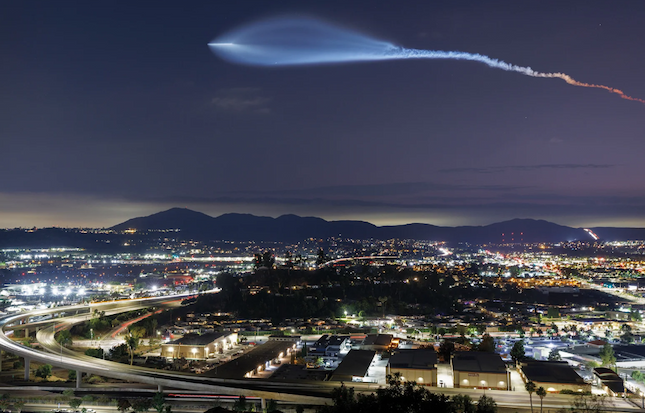
A SpaceX Falcon 9 rocket carrying two dozen Starlink satellites flies into space after launching from Vandenberg Space Force Base in California on July 18, 2025. Kevin Carter/Getty Images
|
|
Battle for the Night Sky
About 15,000 satellites are currently in orbit around Earth. But U.S. and international companies have plans to launch two million satellites in the coming years. More satellites have many benefits on the ground—fast Internet in remote places—but the more objects in orbit the higher the risk of collision. Not to mention a cluttered night sky that makes ground-based astronomy impossible.
Collision risks: Before SpaceX’s Starlink, a typical satellite would adjust its course three or four times a year to avoid a collision with another object. Those maneuvers would be overseen by humans and worked out days in advance. But the Starlink constellation currently performs an average of 1,000 maneuvers a day to dodge potential run-ins. According to information SpaceX provided to NASA, every 10 minutes each Starlink satellite recalculates its position and predicts its trajectory for the next 48 hours. If it sees the potential for a collision, the Starlink satellite will fire its thrusters until the risk of collision is less than one in 30 million (well below the accepted industry standard). If SpaceX were to follow through on its plan to launch a million data-center satellites, the constellation would have to perform a billion collision-avoidance maneuvers every year (and there aren’t even one billion seconds in a whole year!). When collisions happen, they can create thousands of pieces of debris, some of which will rain down on Earth’s surface and into other satellites. “We are ripe for a major event to occur,” says Darren McKnight, a space debris expert at LeoLabs in California.
Astronomy impacts: A study published last December found that adding half a million satellites to orbit would mean that almost every single telescope image taken from anywhere on Earth would contain a satellite. Increase that to a million, and there would at times be more visible satellites in the sky than stars. “We wouldn’t be able to do astronomy,” says Samantha Lawler, an astronomer at University of Regina in Saskatchewan. “There’s just no way.”
What can be done: No international body governs Earth’s orbital environment. The U.S. Federal Communications Commission (FCC) is the de facto global standard setter even though they primarily oversee U.S. companies; if a company wants to access U.S. markets, or to downlink to U.S. ground stations, it has to play by the FCC's rules. The International Telecommunications Union (ITU) in Switzerland, which is affiliated with the United Nations, might be closest to international governance in this domain. But the ITU traditionally hasn’t considered Earth’s orbital capacity until now, even though efforts are being made to change this.
|
|
Neuron Computation
Scientists have observed that the neurons’ many branches, called dendrites, can compute information independently of the cell body. The team used new voltage-imaging technology to record activity from parts of individual neurons in the hippocampi of mice. This is the brain region involved in memory and navigation. They saw that as they changed the mice’s environments, individual dendrites on their neurons changed as well—before the cell body.
Why this is interesting: Traditionally, each of the brain’s 86 billion neurons was assumed to be a single “processor,” operating as one computational unit. But for the past few decades, neuroscientists have suspected that a neuron might house many processors, making it far more powerful. The new study found that individual dendrites on neurons were computing information on their own, preserving traces of the past or getting ahead of the cell body. This means dendrites could serve the brain like local memory devices on a computer.
What the experts say: “Perhaps the best analogy is that a neuron itself is already a neural network,” says Antonio Fernandez-Ruiz, a neuroscientist at Cornell University, who was not involved in the new work. —Emma Gometz, Newsletter Editor
|
|
|
|
|
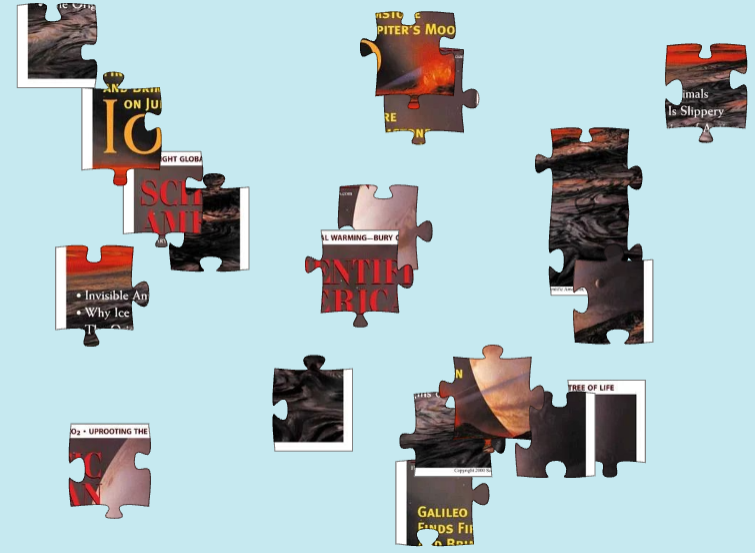
Unscramble this jigsaw puzzle of our February 2000 cover image. This cover shows Jupiter’s volcanically active moon, Io. The feature article associated with the image explores many of the discoveries made by NASA’s Galileo spacecraft, which launched in 1989 and gave scientists the first in-depth view of the Jovian system.
|
|
I remember watching the skies many Augusts ago, trying to glimpse the Perseid meteor shower. At the time, spotting a satellite steadily moving across the night sky seemed like an anomaly, a lucky sighting. But step outside on a clear night nowadays and you will likely see several satellites moving. It's become commonplace, and, for those of us who value seeing stars over machines, it's a bit of a drag.
|
|
What do you think? Are the (many) benefits of unprecedented global connectivity worth the number of satellites planned to orbit Earth? Let me know: newsletters@sciam.com. See you tomorrow.
—Andrea Gawrylewski, Chief Newsletter Editor
|
|
|
|
|
Subscribe to this and all of our newsletters here.
|
|
|
|
|