388 years ago, the famed astronomer and physicist used physics to explain it ͏ ͏ ͏ ͏ ͏ ͏ ͏ ͏ ͏ ͏ ͏ ͏ ͏ ͏ ͏ ͏ ͏ ͏ ͏ ͏ ͏ ͏ ͏ ͏ ͏ ͏ ͏ ͏ ͏ ͏ ͏ ͏ ͏ ͏ ͏ ͏ ͏ ͏ ͏ ͏ ͏ ͏ ͏ ͏ ͏ ͏ ͏ ͏ ͏ ͏ ͏ ͏ ͏ ͏ ͏ ͏ ͏ ͏ ͏ ͏ ͏ ͏ ͏ ͏ ͏ ͏ ͏ ͏ ͏ ͏ ͏ ͏ ͏ ͏ ͏ ͏ ͏ ͏ ͏ ͏ ͏ ͏ ͏ ͏ ͏ ͏ ͏ ͏ ͏ ͏ ͏ ͏ ͏ ͏ ͏ ͏ ͏ ͏ ͏ ͏ ͏ ͏ ͏ ͏ ͏ ͏ ͏ ͏ ͏ ͏ ͏ ͏ ͏ ͏ ͏ ͏ ͏ ͏ ͏ ͏ ͏ ͏ ͏ ͏ ͏ ͏ ͏ ͏ ͏ ͏ ͏ ͏ ͏ ͏ ͏ ͏ ͏ ͏ ͏ ͏ ͏ ͏ ͏ ͏ ͏ ͏ ͏ ͏ ͏ ͏
August 17, 2026—Welcome to a new week of discovery. A new shipping route has opened through the icy top of the world. Plus, how Galileo determined that giants can't exist in our world and a stunning new view of the Lion Nebula. Let's go!
—Andrea Gawrylewski,
Chief Newsletter Editor
|
|
The James Webb Space Telescope captured the clearest view yet of the planetary nebula NGC 2392, nicknamed the Lion Nebula. This dying star looks like the nose of a lion, with a mane of space dust. | 1 min read
El Niño powered up Hurricane Lala, which swung just south of Hawaii over the weekend. Here's how. | 3 min read
To categorize the musical nuance of famous musicians, scientists trained machine-learning models on 84 hours of jazz, including 1,629 performances by 20 famous jazz pianists such as Chick Corea, Thelonious Monk, Oscar Peterson and Bill Evans. | 2 min read
A puzzle about dots on the page, called the "happy ending problem," led to a branch of modern math about order among chaos. | 6 min read
Feral hogs roam in 35 U.S. states, and the federal government plans to spend millions to help eradicate them. But what do experts make of these efforts? | 4 min read
An AI speech synthesis device helped a nonspeaking person with autism and apraxia perform in an opera. | 25 min podcast
|
|
Your group chat has enough opinions. Add some evidence. Subscribe to Scientific American and support this newsletter with 90 days for $1.
|
|
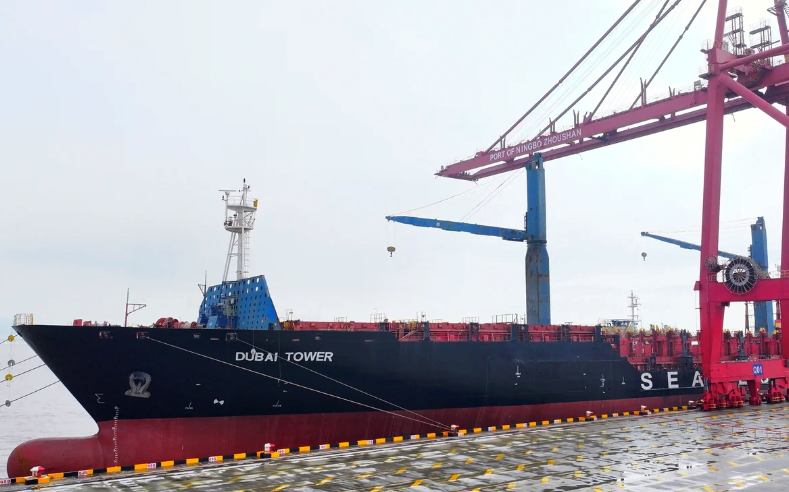
A Chinese ship set to begin the first weekly container service through the Arctic. CN-STR / AFP via Getty Images) / China OUT
|
|
Ships at the Top of the World
A Chinese shipowner plans to begin summer container service this week through the Arctic on an express route to Europe. Its route runs along the northern coast of Russia to Europe via the North Sea. The subpolar route is shorter than the standard one—so the trip takes about 20 days compared with around 40. But it would never have been possible to make the journey without climate change. Enough ice has melted to allow cargo ships through: the 17 summers with the lowest Arctic sea-ice cover on record have occurred in the past 20 years. NASA data, meanwhile, show the Arctic sea-ice extent is shrinking by about 12 percent every decade.
Environmental concerns: Expanding Arctic shipping could result in more black carbon emissions from shipping fuel that could cause the sea ice to melt more quickly. Heavy fuel oil—a cheap, high-energy, tarlike material that is left over from refining crude oil—has been banned in the Arctic by the International Maritime Organization since 2024, but loopholes still exist. Cargo ships are also not necessarily equipped to deal with conditions and ice flow along the route, potentially increasing the risk of oil spills and accidents.
What the experts say: At the moment, new international agreements to govern Arctic shipping seem unlikely: Russia alone sets regulations for the Northern Sea Route. Environmentalists fear that, without enforcement, efforts to open the region to global shipping risk destroying the fragile ecosystem. The shrinking ice cover will “absolutely” result in increased shipping along the Northern Sea Route during the summer months, says Anastasios Leonburg, a marine risk consultant for the insurer Allianz Commercial and a former merchant ship captain.
|
|
Galileo's Giant Theory
Giants are a common foe in fantasy, but could the laws of physics allow them to really exist? In his foundational 1638 text “Dialogues Concerning Two New Sciences,” Galileo Galilei argues that the giants of folklore are fundamentally flawed. He uses the example of a load-bearing beam to puzzle this out: the issue lies in the difference between how area, or the beam’s strength, scales differently than its volume, or the beam’s weight. If the beam is scaled up by a factor of 10, it can support 100 times the weight. But as the beam grows, the weight of the beam would increase 1000-fold. Therefore, Galileo argues that any given beam will have a certain sufficiently scaled-up size at which it will no longer support even its own weight.
How this translates to giants: If an ordinary human was scaled up to the size of a giant, that person’s bone density would not be able to support her massive size. All of these scaled-up objects—from a giant-sized sword to a giant-sized flagon of ale—would either get crushed under their own weight or be too heavy for a giant to lift. Galileo said it himself: “Clearly then if one wishes to maintain in a great giant the same proportion of limb as that found in an ordinary man he must ... find a harder and stronger material for making the bones ... for if his height be increased inordinately he will fall and be crushed under his own weight.”
We see this in nature: Elephants, for example, have much thicker legs relative to their size than dogs and cats. The bones themselves need to become proportionally thicker to support the increased weight of the elephant. This is apparent across much of evolutionary biology: body shapes are not simply scaled exactly up and down but reworked to accommodate this physics rule that Galileo so deftly observed. —Emma Gometz, Newsletter Editor
|
|
|
|
|
In an interview with Scientific American, X-files series creator Chris Carter says that Agent Dana Scully, a trained medical doctor, makes up the beating heart of the show with her commitment to science. "If it weren't for Scully, the X-Files would've been about a guy poking around in the paranormal, no one challenging him, and he'd be in that FBI basement office a forgotten man," Carter says. Watch the full interview here.
|
|
An ordinary die is labeled with numbers from 1 to 6. These numbers are arranged on the die such that the sum of the numbers on opposite faces—called the die constant—always equals 7. Label the faces of a special die with six different prime numbers so that the die constant is as small as possible.
Click here for the solution.
|
|
Italy's cheese economy is straining under climate change. Extreme heat is threatening the vaults where banks are holding wheels of Parmigiano as loan collateral. | Fortune ($)
Who's afraid of needles? Nearly one in five people have used at-home injections for treatments ranging from GLP-1s to I.V.F. drugs to peptides. | The New York Times ($)
Gene therapy holds promise for treating rare, incurable illnesses in children. But after two recent deaths, debate is growing over the risks. | Gizmodo
|
|
I recently finished reading The Wide Wide Sea by Hampton Sides, which tells the riveting tale of Captain James Cook's final voyage. Some will know that Cook was killed in 1779 in the shallow waters of Kealakekua Bay while attempting to kidnap the main chief of the Big Island of Hawaii. But Cook only came across the Hawaiian islands by chance as he carried out his true mission: To find a way to travel through the Northwest Passage, seeking a sailable route connecting the Atlantic and Pacific Oceans through the Arctic Ocean. Centuries of European explorers had attempted to find and secure the route to no avail. As Cook and his predecessors discovered, no throughway at the time existed—only an impenetrable wall of ice. What a different Arctic we've made in 250 years.
|
|
—Andrea Gawrylewski, Chief Newsletter Editor
|
|
|
|
|
Subscribe to this and all of our newsletters here.
|
|
Scientific American
1000 N West Street, Suite 1200
|
|
|
|
|