Plus, oceans hit record temps ͏ ͏ ͏ ͏ ͏ ͏ ͏ ͏ ͏ ͏ ͏ ͏ ͏ ͏ ͏ ͏ ͏ ͏ ͏ ͏ ͏ ͏ ͏ ͏ ͏ ͏ ͏ ͏ ͏ ͏ ͏ ͏ ͏ ͏ ͏ ͏ ͏ ͏ ͏ ͏ ͏ ͏ ͏ ͏ ͏ ͏ ͏ ͏ ͏ ͏ ͏ ͏ ͏ ͏ ͏ ͏ ͏ ͏ ͏ ͏ ͏ ͏ ͏ ͏ ͏ ͏ ͏ ͏ ͏ ͏ ͏ ͏ ͏ ͏ ͏ ͏ ͏ ͏ ͏ ͏ ͏ ͏ ͏ ͏ ͏ ͏ ͏ ͏ ͏ ͏ ͏ ͏ ͏ ͏ ͏ ͏ ͏ ͏ ͏ ͏ ͏ ͏ ͏ ͏ ͏ ͏ ͏ ͏ ͏ ͏ ͏ ͏ ͏ ͏ ͏ ͏ ͏ ͏ ͏ ͏ ͏ ͏ ͏ ͏ ͏ ͏ ͏ ͏ ͏ ͏ ͏ ͏ ͏ ͏ ͏ ͏ ͏ ͏ ͏ ͏ ͏ ͏ ͏ ͏ ͏ ͏ ͏ ͏ ͏ ͏
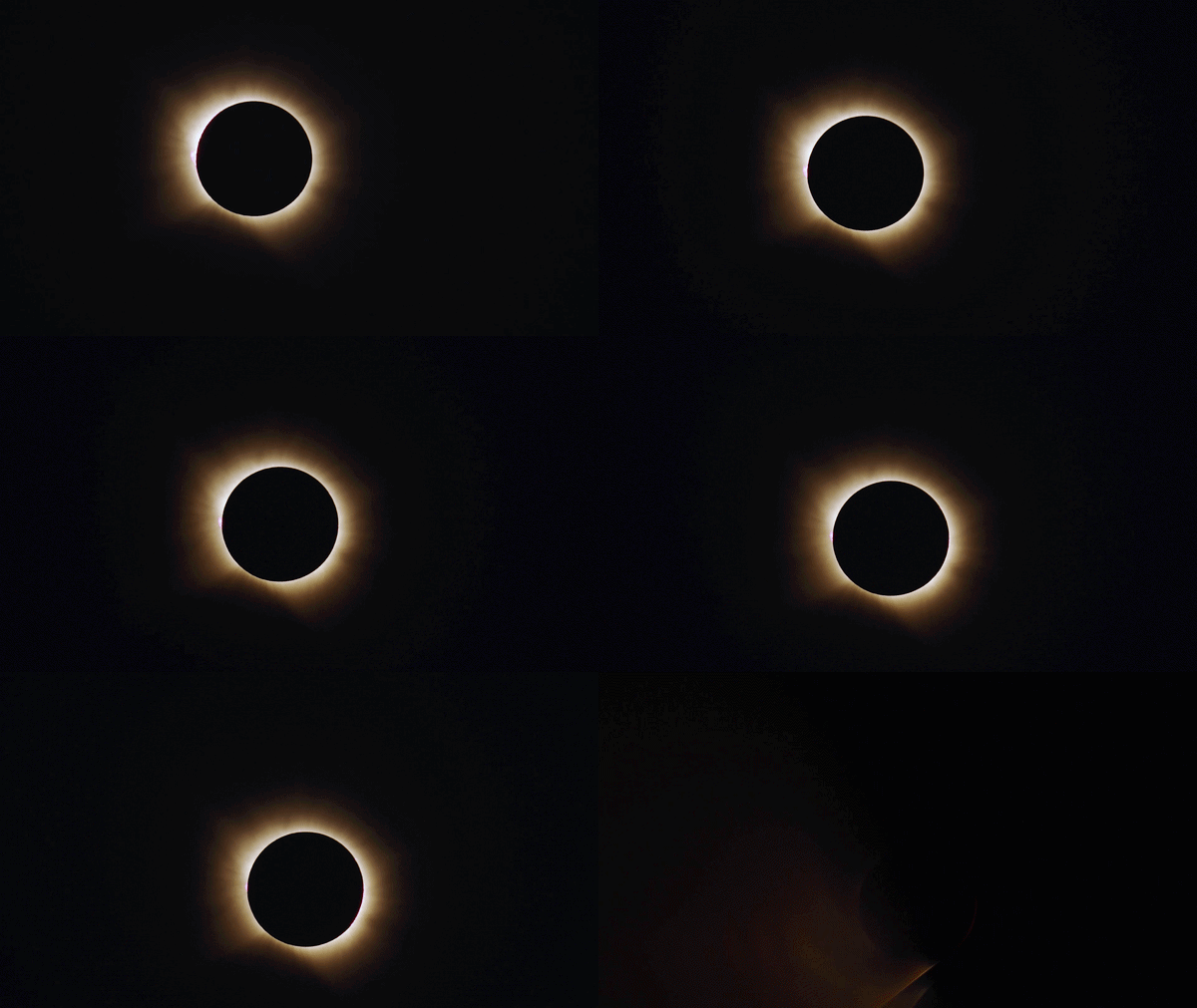
August 12, 2026—Happy eclipse day! Viewers in Europe have already seen some stunning views of totality. Follow along with live updates on our site. Plus, oceans have hit record temperatures and Emma Gometz explores a wild surf destination.
—Andrea Gawrylewski
Chief Newsletter Editor
|
|
Timelapse of April 12 eclipse, Arauzo de Torre, Spain. Lucie McCormick
|
|
Follow all the latest updates and learn everything you need to know about today's solar eclipse, already underway in parts of the world. | 5 min read
Check out a collection of eclipse photos from around the world. | 2 min read
Yesterday, the record holder for land speed in a car, Andy Green, shattered the land speed record for a hydrogen car, reaching 406 mph. | 2 min read
The National Academy of Sciences pulled a chapter on climate from its scientific reference manual for judges. President Donald Trump and other Republican officials had criticized the chapter as biased against fossil fuel companies. | 2 min read
Anthropic announced Monday that its model Claude had made significant progress on an unresolved aspect of the inscrutable math equation called the Riemann hypothesis. | 3 min read
Astronomers glimpse one of the earliest-known "black hole stars" from the dawn of time. | 3 min read
Could humans learn a language made entirely of music? Our podcast investigates. | 24 min podcast
See striking drone footage of hundreds of cownose stingrays swarming off the coast of New York. It's mesmerizing! | 1 min read
|
|
All science, all the time. Read about what you care about with a subscription to Scientific American. Try it out for 90 days for just $1!
|
|
Record Ocean Temperatures
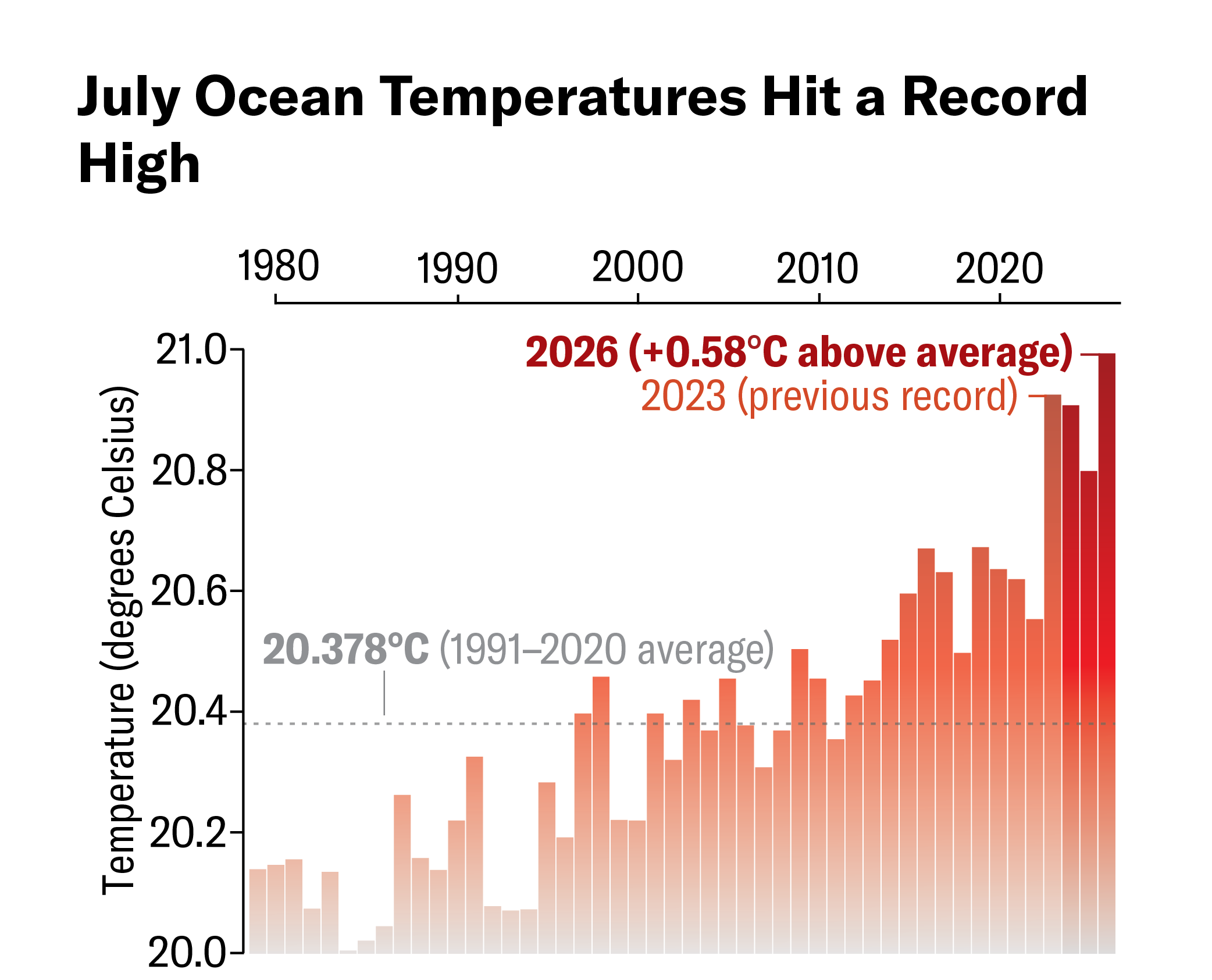
World ocean temperatures hit a record high for July this year, according to a new report from the European Union’s Copernicus climate monitoring service. Sea surface temperatures, measured at 10 meters deep, averaged 20.96 degrees Celsius (69.7 degrees Fahrenheit) in July. This included all global oceans aside from the polar regions. The record was fueled by El Niño conditions in the tropical Pacific Ocean—this climate event is typically marked by warmer ocean temperatures.
|
|
Sanidhya Sharma; Source: ERA5 data, Copernicus Climate Change Service/European Center for Medium-Range Weather Forecasts.
|
|
Your Next Surf Trip: Titan?
Saturn’s moon Titan is huge—bigger than the planet Mercury—and it has one thing that no other world in our solar system can boast (other than Earth of course): persistent liquid on its surface. Yeah, we’re talking huge lakes, several times the surface area of all the U.S. Great Lakes combined. But Titan’s surface temperature is frigid: -300 degrees Fahrenheit. So rather than water, the lakes are full of liquid methane. Could you still surf? Columnist Phil Plait has answers for you, anxious traveler.
Waves on Titan: Titan’s lower gravity, as well as liquid methane’s lower density, does change how waves behave. To see what those effects might be, a team of scientists modeled how wind and surface liquids interact to create waves and applied them to Titan. They found that waves start to pick up at lower wind speeds on Titan and could grow to be much larger than waves on Earth driven by similar winds. For example, they found that a wind speed of 10 meters per second generates waves that are 15 meters high—as tall as a five-story building!
So could you surf? First, humans are twice as dense as liquid methane, so don’t fall into the methane lake—you won’t be able to get out. But if you bring a board that’s twice as big as a surfboard to combat those effects, you could, in theory, ride a wave! And according to the model, waves would move more slowly on Titan than on Earth, so catching one would be a little easier. But balancing on the huge board with your lower weight (due to Titan’s diminished gravity) would certainly prove to be difficult, and that’s all while making sure you don’t accidentally launch yourself off it! But hey, who wouldn’t want to catch an alien wave, gravity or no? —Emma Gometz, Newsletter Editor
|
|
|
|
|
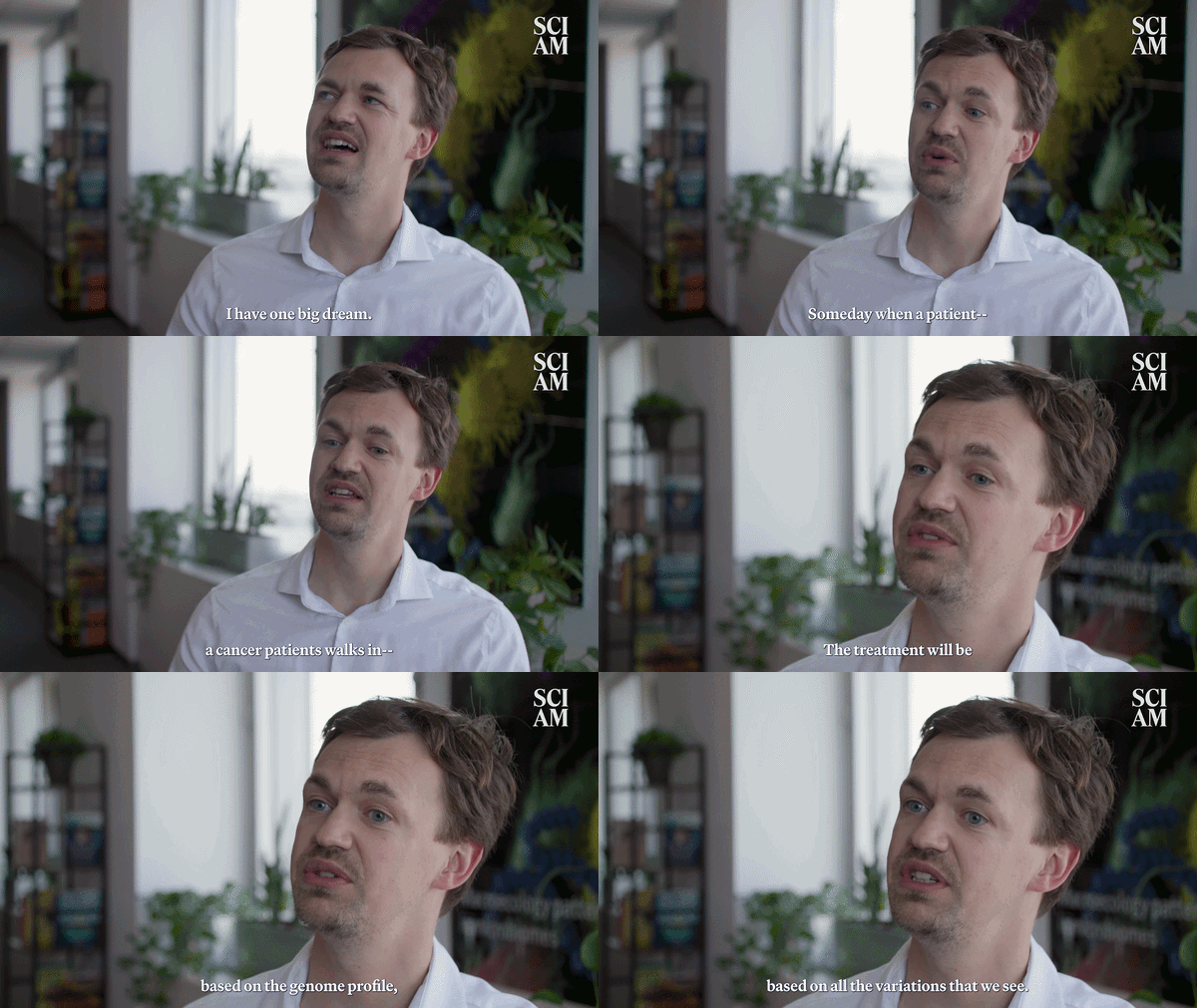
Mikhail Kolmogorov, a scientist at the National Cancer Institute, is on the hunt for genetic markers of cancer. His team devises algorithms that can detect structural variations in chromosomes that may drive as many as half of all cancers. One model he devised, called Severus, in a test in 17 pediatric leukemia patients, confirmed five genetic drivers already known from traditional testing, as well as four additional genetic drivers that were missed by standard methods. The goal of his work, Kolmogorov says, is to build personalized genomics testing that will become routine for every cancer patient.
Read all the Young American Scientist profiles here.
|
|
Based on a new analysis of dodo skulls, we may owe them an apology. | Gizmodo
We can finally use bacteria from a crime scene to solve cases. | New Scientist
Flock's 120,000 traffic cameras log every drive you've taken in the last several years. Police can access the data at will. | The New York Times ($)
|
|
We have reporters on the ground in multiple locations in Europe gathering footage and imagery of the eclipse. If you saw partial or totality today (or this evening) and captured a good photo of it, do send it my way and I'll potentially feature it in an upcoming newsletter! And don't forget to look out for meteors tonight!
|
|
In the meantime, send any other comments, observations or questions: newsletters@sciam.com. I'll be back tomorrow.
—Andrea Gawrylewski, Chief Newsletter Editor
|
|
|
|
|
Subscribe to this and all of our newsletters here.
|
|
Scientific American
1000 N West Street, Suite 1200
Wilmington, Delaware 19801
|
|
|
|
|