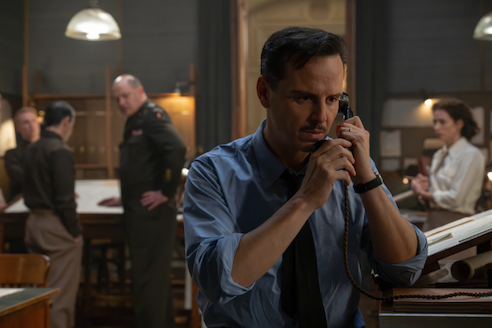
The uncertainty of weather forecasts comes to the big screen today. In Pressure, actor Andrew Scott plays Captain James Stagg, the scientist who advised president Dwight D. Eisenhower (played by Brendan Fraser) to move the Allied invasion of Europe from June 5 to June 6, 1944, to avoid a catastrophic storm. In war, bad weather really matters.
The film comes to theaters today, but our Earth and Environment editor Andrea Thompson got to see it early. My colleague Emma Gometz sat down with Andrea to talk about her impression of the film, the science that inspired it, and whether (weather?) it's worth the watch.
Emma Gometz: Let's start with business. How did you like the movie?
Andrea Thompson: I enjoyed it! I’m of course the exact target audience for this film—I’m a history buff and a weather nerd. But I think they did an excellent job of keeping a gripping sense of tension, even though the history of D-Day is already known. That tension happens at a more personal level, and because they’re racing against the clock you’re able to suspend what you know going in.
EG: How did you feel about the way the movie handled period-accurate meteorology?
AT: The movie centers around forecasting the weather at a time when that science was still fairly rudimentary. There were no satellites or computers. Forecast teams received data by telephone from various outposts, ships and planes and then had to plot maps by hand—forecasting just three days in the future was no more than a semi-informed guess. The team really did their homework though, working with the U.K.’s Met Office and retired meteorologists to make sure the maps looked right and they were using the correct lingo while keeping it very accessible for the audience. They also found and colorized archival footage of weather balloons that were released during the war, which I thought was a particularly cool touch.
EG: Why did this film stand out to you?
AT: I love whenever pop culture can help people better understand science and how it works and what it can—and can’t—do. One major throughline of the movie is Andrew Scott’s character, Captain James Stagg, emphasizes that he has to look at the evidence and data he has—he can’t wish-cast the scenario the generals would prefer. Another is dealing with uncertainty. General Eisenhower (played by Fraser) asked Stagg several times if he’s certain about his forecast, and Stagg answers honestly, “No.” He can’t be certain because forecasts—like any scientific finding—come with some degree of uncertainty. Showing those aspects of science in action is, I think, really powerful.
Andrea will be writing about
Pressure and including some additional behind-the-scenes details in her Earth & Environment newsletter on Wednesday, so make sure to
sign up to receive that in your inbox.