A muon detector can create a 3-D map of underground tomography ͏ ͏ ͏ ͏ ͏ ͏ ͏ ͏ ͏ ͏ ͏ ͏ ͏ ͏ ͏ ͏ ͏ ͏ ͏ ͏ ͏ ͏ ͏ ͏ ͏ ͏ ͏ ͏ ͏ ͏ ͏ ͏ ͏ ͏ ͏ ͏ ͏ ͏ ͏ ͏ ͏ ͏ ͏ ͏ ͏ ͏ ͏ ͏ ͏ ͏ ͏ ͏ ͏ ͏ ͏ ͏ ͏ ͏ ͏ ͏ ͏ ͏ ͏ ͏ ͏ ͏ ͏ ͏ ͏ ͏ ͏ ͏ ͏ ͏ ͏ ͏ ͏ ͏ ͏ ͏ ͏ ͏ ͏ ͏ ͏ ͏ ͏ ͏ ͏ ͏ ͏ ͏ ͏ ͏ ͏ ͏ ͏ ͏ ͏ ͏ ͏ ͏ ͏ ͏ ͏ ͏ ͏ ͏ ͏ ͏ ͏ ͏ ͏ ͏ ͏ ͏ ͏ ͏ ͏ ͏ ͏ ͏ ͏ ͏ ͏ ͏ ͏ ͏ ͏ ͏ ͏ ͏ ͏ ͏ ͏ ͏ ͏ ͏ ͏ ͏ ͏ ͏ ͏ ͏ ͏ ͏ ͏ ͏ ͏ ͏
May 12, 2026—A startup company harnessing particle physics to aid mineral mining. Plus, Emma Gometz is back with more on native bees, and the story of how computer scientist Margaret Hamilton saved the first moon landing.
—Andrea Gawrylewski
Chief Newsletter Editor
|
|
Margaret Hamilton. NASA Image Collection/Alamy
|
|
- NASA’s Apollo moon missions relied on computer scientist Margaret Hamilton, who designed safety features inspired in part by her four-year-old. | 6 min read
- There is no cure for the hantavirus that has sickened nine and killed three people, but several therapies have shown promise in animal studies. Lack of funding means that potential therapies for humans are years away. | 4 min read
- Researchers documented seven cases of remoras, a fish known for suctioning itself onto rays and other marine species, plunging into manta rays' cloacal orifices...their butts. | 2 min read
- Polycystic ovary syndrome (PCOS) has been renamed to polyendocrine metabolic ovarian syndrome (PMOS), which is more accurate and should bolster research, a global consortium of experts announced today. | 2 min read
- Researchers who study political violence say the U.S. is in a period of more intense political rhetoric, but there have been far darker periods in the nation’s history. | 5 min read
- For the last 1.7 million years, China’s Yangtze River has been stealing water from the Yellow River, new research shows. | 2 min read
- NASA’s Mars rovers have found traces of minerals that make up gems like sapphires, rubies and opals on Earth. But their appearance and abundance on Mars is likely very different, experts say. | 3 min read
- SpaceX's Starship V3 megarocket successfully completed its launch dress rehearsal. | 2 min read
|
|
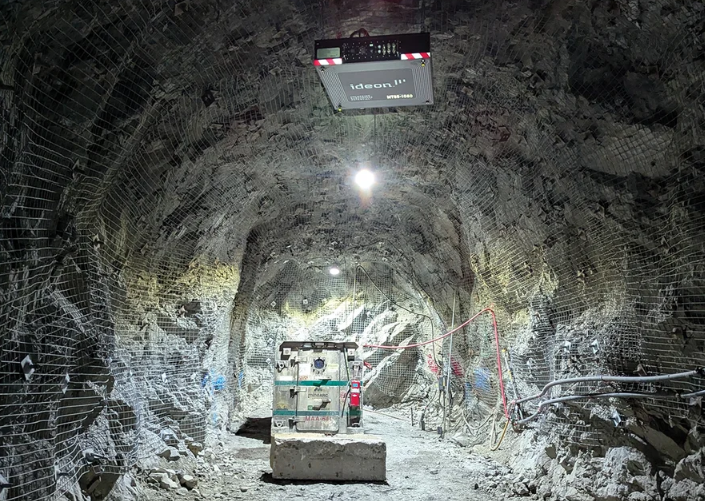
An Ideon muon detector scans for hidden ore deep inside a Nevada mine tunnel. Alan Madsen/© Ideon Technologies
|
|
|
Particle Detectors for Mining
|
Miners are turning to particle physics to help them find mineral ore. A spinoff startup company from Canada’s national particle-accelerator center now offers a particle detector that creates high-resolution mapping of underground tomography. Muons are subatomic particles produced by the interaction of cosmic rays from supernova explosions that interact with matter as they slam into Earth’s upper atmosphere. They are constantly raining down and passing through all matter on Earth’s surface. Placing detectors underground and measuring arriving muons makes it possible to create a high-res, cone-shaped, 3-D map of the surrounding rock, signaling to miners where ore is depleted and where dangerous air gaps might exist.
Why this matters: Demand for critical minerals like copper and palladium far outpaces the rate at which such materials are mined. The global refined-copper shortfall will hit 330,000 tons this year and could widen to as much as eight million tons by 2035, according to one source. The United Nations predicts that demand for critical minerals could triple by 2030. New tech like muon detectors and AI models that scan previously depleted deposits for new prospects are slowly being adopted to help.
What the experts say: “We’ve kind of industrialized particle physics,” says Gary Agnew, the co-founder and CEO of Ideon Technologies, which developed the muon detector. “The technology used to find hidden chambers in the pyramids is now working in mine sites a mile deep, under pressure, under temperature.”
|
|
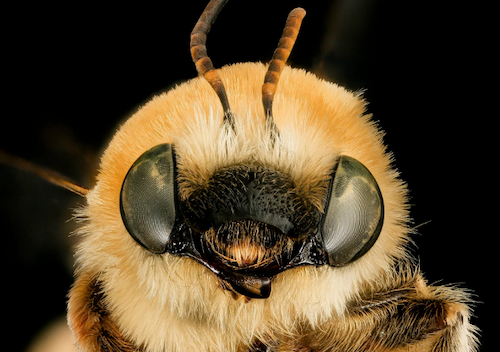
A Martinapis luteicornis bee found in the desert in Cochise County, Arizona. Amanda Robinson/USGS Bee Lab via Flickr
|
|
The honeybee most of us in the U.S. know and love, Apis mellifera, is actually a European import brought over from England to Virginia in 1622. But there are more than 4,000 native bees in the U.S., and they’re quite different from what you expect from your typical honeybee. Although they don’t get as much public attention, Sydney Shumar, a biologist and manager of the U.S. Geological Survey’s Bee Lab, says that native bees serve important functions in our ecosystems—and they need our help.
Native bee quirks:
- Unique look: Native bees are specialists, and many are adapted specifically to pollinate a certain plant or plants in a specific region. Different species can live in lush, verdant areas, or dry, arid deserts. Each species can have wildly different shapes and colors from the others, as well as different ways they collect pollen and nest.
- No hives or honey: Native bees either live in the ground or nest in plant stems; they don’t produce wax, honey, or hives!
- Seldom queens: Of the native bees, only bumblebees have queens. While males and females have differences in the other species, they’re not as exaggerated as queens or drone males.
- Less problematic stings: Native bees don’t have barbed stingers, so their stings hurt a bit less than honeybees. Also, it means native bees can pull their stinger out of their victim and keep on buzzing, unlike honeybees who have to tear out parts of their bodies to pull away from a sting, which causes them to die.
What the expert says: Native bee populations are generally declining because of major losses in suitable habitat. But “the most well-researched and well-documented way of trying to introduce native bees to your area is to plant their habitat and plant their food source,” Shumar says. “Even if you have an apartment, if you have a little garden area or a pot, put some native plants in there, and I think you’ll be astounded by what you wind up seeing coming to visit.” —Emma Gometz, newsletter editor
|
|
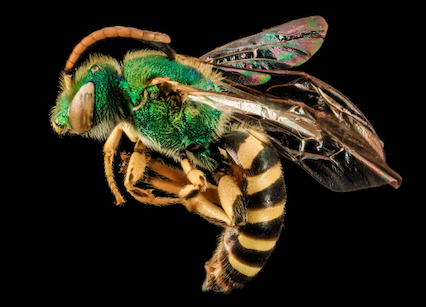
An Agapostemon sericeus found in Prince George’s County, Maryland. The genus Agapostemon is full of bright blue or green, metallic-looking bees that are classified as “sweat bees,” even though, unlike their relatives, they are not attracted to human sweat. Wayne Boo/USGS Bee Lab via Flickr
|
|
|
|
|
|
SCIENTIFIC AMERICAN TRAVEL
|
|
Space Now Open for Icelandic Eclipse Adventure
|
|
New availability! Grab your spot while they last and experience the 2026 solar eclipse in the Land of Ice and Fire on this trip of a lifetime led by Senior Editor Andrea Thomspon.
|
|
|
|
|
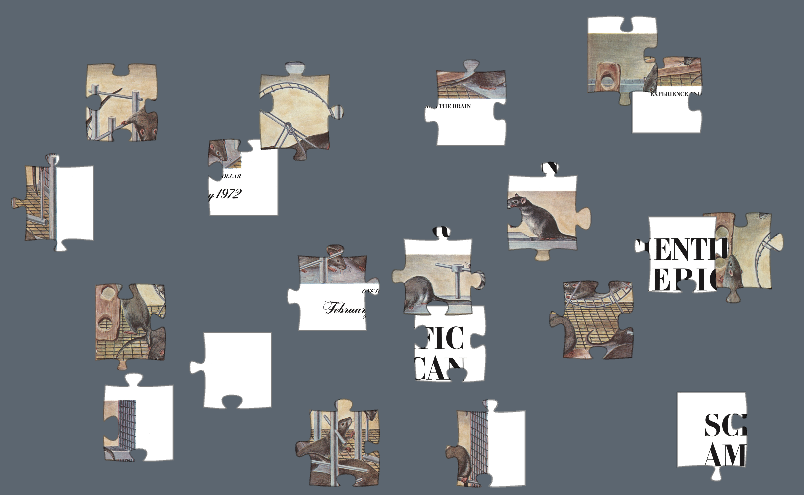
- Can you unscramble this image of our February 1972 cover? This cover shows rats playing in an enriching environment, which scientists have found promotes the animals’ cerebral development. It’s just one of the ways that experiences change the structure of the brain.
|
|
Particle physics being used for critical mineral mining? People sometimes ask me what the value in basic research is—why should we spend money as a society on simply understanding how the universe works, from the tiny scale of cells to the cosmic scale of colliding black holes? My answer usually summons up an example very near to particle physics and mining. Scientific research keeps proving that the distance between any two fields of human knowledge is shorter than it appears.
|
|
—Andrea Gawrylewski, Chief Newsletter Editor
|
|
|
|
|
Subscribe to this and all of our newsletters here.
|
|
|
|
|