NASA has ambitious plans to install a permanent habitat on the moon ͏ ͏ ͏ ͏ ͏ ͏ ͏ ͏ ͏ ͏ ͏ ͏ ͏ ͏ ͏ ͏ ͏ ͏ ͏ ͏ ͏ ͏ ͏ ͏ ͏ ͏ ͏ ͏ ͏ ͏ ͏ ͏ ͏ ͏ ͏ ͏ ͏ ͏ ͏ ͏ ͏ ͏ ͏ ͏ ͏ ͏ ͏ ͏ ͏ ͏ ͏ ͏ ͏ ͏ ͏ ͏ ͏ ͏ ͏ ͏ ͏ ͏ ͏ ͏ ͏ ͏ ͏ ͏ ͏ ͏ ͏ ͏ ͏ ͏ ͏ ͏ ͏ ͏ ͏ ͏ ͏ ͏ ͏ ͏ ͏ ͏ ͏ ͏ ͏ ͏ ͏ ͏ ͏ ͏ ͏ ͏ ͏ ͏ ͏ ͏ ͏ ͏ ͏ ͏ ͏ ͏ ͏ ͏ ͏ ͏ ͏ ͏ ͏ ͏ ͏ ͏ ͏ ͏ ͏ ͏ ͏ ͏ ͏ ͏ ͏ ͏ ͏ ͏ ͏ ͏ ͏ ͏ ͏ ͏ ͏ ͏ ͏ ͏ ͏ ͏ ͏ ͏ ͏ ͏ ͏ ͏ ͏ ͏ ͏ ͏
May 11, 2026—Today, we have more details on NASA's ambitious moon base plan. Plus, scientists write an open letter denouncing the firing of the NSF's board, and experts weigh in on how much protein you actually need.
—Andrea Gawrylewski
Chief Newsletter Editor
|
|
Three of the five puppies born in Denali National Park & Preserve. NPS Photos / K. Karnes
|
|
- Alaska’s Denali National Park just introduced its newest litter of five future sled dogs to add to its pack of more than 30. | 3 min read
- In an open letter, thousands of scientists criticized the White House’s firing of the NSF’s entire governing board in April as "an alarming attack" on U.S. science. | 3 min read
- Protein is being added to everything from Starbucks' cold foam to Pop-Tarts. Here's how much protein scientists say you actually need. | 5 min read
- Several teams appeared to spend the second half of the U.S. professional basketball season losing games on purpose for a better chance at a high draft pick. Could math help fix this problem? | 4 min read
- Scientific American sits down with Lindy Elkins-Tanton, principal investigator of NASA’s Psyche mission, to discuss her new book in which she gathers lessons from interplanetary exploration to help people solve problems together. | 6 min read
- The alien world L 98-59 d might occupy a new class of molten, sulfurous exoplanet. New telescopes may be able to find more just like it. | 4 min read
|
|
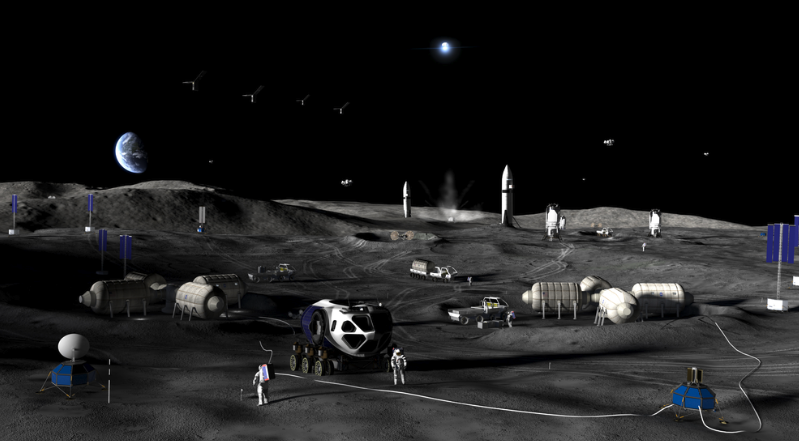
NASA proposed an ambitious line-up of trips to the moon in order to establish a habitat there by 2036. The plan partly began last December when the Trump administration issued an executive order telling NASA to turn its exploration focus to the moon. According to this order, the space agency’s priorities should include landing people on the moon by 2028 and starting a permanent lunar outpost by 2030. “There’s a lot that we got to think through ... to be on that Artemis XVIII mission,” which would land astronauts on the moon and equip them with a base and a rover, said NASA’s acting associate administrator Greg Stover, at an April meeting at the Johns Hopkins University Applied Physics Laboratory (APL) in Maryland. “When we talk about living and working on the moon, it’s not just a single mission. It’s an ecosystem.”
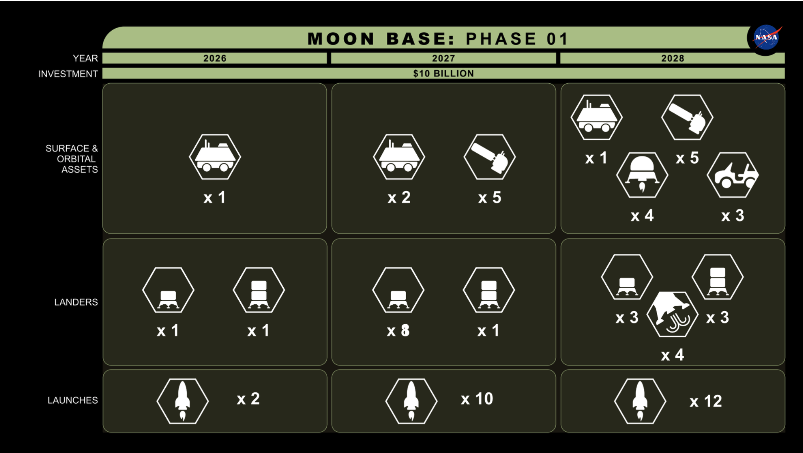
How it will happen: NASA is planning a three-part moon base plan. First, it aims to land astronauts on the moon by 2028. Next, it will build a base at the lunar south pole and begin bringing astronauts there every six months by 2032. Finally, the agency will establish a nuclear-powered permanent outpost by 2036. This $30-billion, 11-year plan calls for 79 launches, 73 landers, 10 moon buggies, 12 “hopper” rocket drones, four habitat modules and numerous other pieces of infrastructure, including a 20-kilowatt nuclear reactor. To accomplish this giant feat, the agency will have to rely on the growing private space industry.
|
|
The first $10-billion phase of NASA’s moon base plan. NASA
|
|
Location: NASA is targeting the dramatically cratered surface on the lunar south pole for its moon base. And with good reason: In the deep wells of craters, scientists hope to find water and other resources vital to a moon mission. But some observers have raised concern about a land rush that would exploit the lunar south pole’s riches. “You have this truly special place that has a record of the early Earth tied to it, and you really get only one shot at [exploring] it,” says astronomer Aaron Boley, co-director of the Outer Space Institute at the University of British Columbia. “If you screw it up, you really screwed it up.”
Lander: NASA doesn’t even have a usable moon lander yet. It plans to pit SpaceX and Blue Origin against each other to deliver working landers next year for a test of docking and operations in Earth orbit on the Artemis III mission. The SpaceX contender is a lunar lander version of its Starship upper-stage rocket, which has yet to reach Earth orbit. Meanwhile, Blue Origin will make its first attempt at landing a rover, NASA’s Volatiles Investigating Polar Exploration Rover (VIPER), on the lunar south pole—the planned setting for the moon base.
|
|
|
|
|
|
A SPECIAL EVENT WITH SCIENTIFIC AMERICAN
|
|
What’s a Quantum Computer Good For, Anyway?
|
|
Quantum computing’s revolutionary potential is one of the most tantalizing prospects for technological breakthroughs in the 21st century. But what’s real, and what’s hype? In principle, quantum computers offer enormous performance boosts for certain applications in cryptography, telecommunications, materials science, and fundamental physics. In practice, such breakthroughs remain as yet unrealized. Join Scientific American editors Lee Billings, Clara Moskowitz and Eric Sullivan for an engaging discussion on the promise and peril of quantum computing.
|
|
|
|
|
- The long-anticipated “solar singularity”—where renewables become cheaper and more dominant than fossil fuels—has arrived, but booming AI data centers now threaten to overwhelm clean-energy gains with surging electricity demand, writes Tamlyn Hunt, a scholar at the University of California, Santa Barbara. Some projections estimate that AI-driven data centers may consume up to 20 percent of U.S. electricity by 2030. A "collision between the clashing exponential curves of renewable energy supply and AI energy demands” could force a renewed reliance on fossil fuels, he says. | 5 min read
|
|
-
The nine rectangles A, B, C, D, E, F, G, H and I overlap one another. Rectangle A intersects rectangles D and F; this relation can be written in shorthand as A\(D, F). Furthermore,
B\(F, G)
C\(G, H)
D\(A, H)
E\(H, I)
F\(A, B, I)
G\(B, C, I)
H\(C, D, E)
I\(E, F, G)
Label the rectangles correctly with the letters A to I.
Click here for the solution.
|
|
- An investigation shows that the Trump Administration exempted the biggest polluters from adhering to the Clean Air Act. All they had to do was send an email requesting it. | ProPublica
- How to know when the collapse of society is imminent? One artist made a warning system that tracks billionaires' private jets and alerts you if they all flee city centers at once. | The Washington Post
- California’s wildfires have prompted a flurry of tech designed to defend homes. Much of it remains expensive and unproven. | Los Angeles Times
|
|
If you want to fully heal your soul, the best recommendation I have is to visit the sled dogs at Denali National Park in Alaska. I was lucky enough to do this in summer of 2022, and it was one of the highlights of my trip to the Last Frontier (or maybe even of my life?). The dogs each have their own mini cabins and many romp with each other and will let you pet them. Local volunteers take each dog on daily walks (my future profession if this journalism thing doesn't work out). And yes, you can pet the puppies.
|
|
—Andrea Gawrylewski, Chief Newsletter Editor
|
|
Andrea Gawrylewski/Scientific American
|
|
|
|
|
Subscribe to this and all of our newsletters here.
|
|
|
|
|