May 27, 2026—Our galaxy and our nearest neighboring galaxy may be on a collision course, all atoms might be unique, and NASA unveils new moon landers and rovers.
—Andrea Gawrylewski
Chief Newsletter Editor
P.S. Science is more fun with friends. If you’re enjoying this newsletter, consider forwarding it to someone else who might love it, too.
|
|
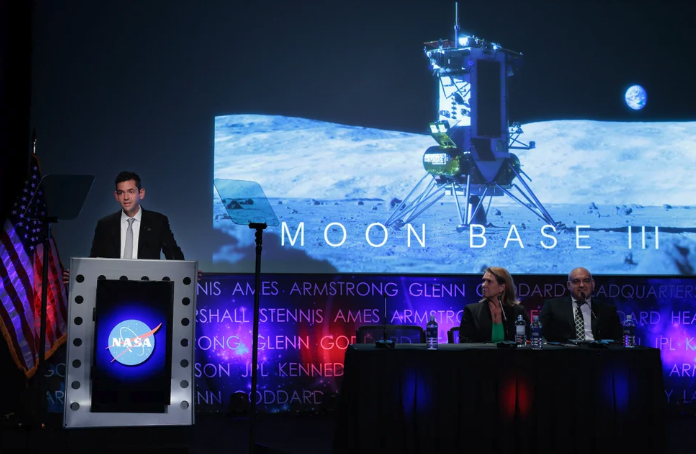
NASA administrator Jared Isaacman at a NASA moon base news conference on May 26, 2026. Chip Somodevilla/Getty Images
|
|
- At an event at NASA Headquarters yesterday, space agency officials unveiled the first rovers and landers headed to the future site of the planned lunar south pole outpost. | 4 min read
- A global fleet of around 60 specialized vessels lay and maintain the world’s undersea Internet cables, but fewer than 20 of these ships are dedicated solely to repair, which is the true vulnerability. | 2 min read
- A toothless, beaked, bipedal ancient cousin of crocodiles lived some 200 million years ago, according to a new fossil analysis. | 2 min read
- Mysterious "little red dots" spotted by the James Webb Space Telescope were dated to a mere 700 million years after the big bang and are generally thought to be black holes. Now astronomers have calculated the mass of these objects and the results might upend cosmic history. | 5 min read
- Researchers identified signs of biological aging conserved across multiple mammalian species, including humans. | 3 min read
- Speaking of aging, scientists found that amputated tissue from a sea cucumber tissue keeps on living—possibly forever. | 3 min read
- Anthropic, the maker of the chatbot Claude, has been consulting theologians and ethicists on Claude’s behavior, raising questions about who gets to shape a chatbot’s values. | 4 min read
Join the discussion: Should religious thinkers help shape AI? Or should chatbot values be shaped through secular, technical processes instead? Share your thoughts by joining our discussion.
|
|
Somewhere, a black hole is evaporating incredibly slowly. This $1 offer will disappear much faster. Subscribe to Scientific American for 90 days and support science journalism you can trust.
|
|
The following is an excerpt from the latest edition of "The Universe," a weekly column by astronomer Phil Plait. I think you'll love Phil's fun and friendly way of explaining the cosmos. Sign up for an alert and read his column first every week.
|
|
When it comes to the Milky Way and Andromeda galaxies, there’s a whole “will they or won’t they” thing going on. In 2012 scientists published their results of Hubble Space Telescope observations examining the motion of Andromeda, the closest large spiral galaxy to our own. They found that, within the observational uncertainties at the time, Andromeda was essentially heading straight for us and would collide with our galaxy in approximately four billion years.
Subsequent studies have cast doubt on this supposedly inevitable smashup. Some showed a clean miss, and others showed a collision after much more time. The latest research, which includes the trajectory-tweaking gravitational effects of several satellite galaxies, indicates the odds of a collision are 50–50—a coin toss.
In a purely pragmatic sense, you shouldn’t lose sleep over an impending collision with Andromeda because this new study suggests it won’t happen (if at all) for another eight billion years or so. But assuming it does occur all those eons in the future, would residents of either galaxy have anything to worry about? This depends, of course, on how exactly such a galactic train wreck unfolds.
A Milky Way-Andromeda collision would see these two titans crashing together at roughly a million kilometers per hour. That’s incredibly fast on human scales but much less so on a cosmic one. The Milky Way and Andromeda each boast a flattened stellar disk well more than 100,000 light-years, or a quintillion kilometers, across, so a million-kilometer-per-hour collision can take hundreds of millions of years to unfold. And even then, the aftermath will still resonate within the newly merged galaxy for billions of years to come.
Andromeda has a mass that is 1.5 trillion times that of the sun, and our Milky Way’s mass is about 800 billion times that of our home star. That is a lot of mass, which means the gravitational attraction between the two galaxies is huge. But importantly, both galaxies are quite large, which means the gravitational effects are more than just a simple attraction.
Let’s imagine a point at which the approaching two galaxies, edge to edge, are separated by 120,000 light-years—the approximate diameter of the Milky Way’s disk…
|
|
Two cars of the exact same make and model may be identical at first glance, but if you look closer, tiny differences may begin to show. Some scientists believe this analogy extends to atoms, even though the assumption that atoms with the same number of protons, neutrons, and electrons are exactly alike is foundational to modern physics. In a recent paper, physicist Mark Raizen of the University of Texas at Austin proposed a series of experiments to coax out potential differences from these seemingly identical particles for the first time.
The experiments: To get extremely precise atomic measurements, Raizen proposed a group of tests that would use a laser to cool and trap individual isotopes in an extremely precise atomic clock. This setup would let researchers detect minute differences between the atoms by examining nuances in the magnetic field created by each one’s spinning nucleus, called the nuclear magnetic moment.
What the experts say: While we don’t know what these experiments would find, or whether all atoms really are all unique, “we like to have theory and experiment march together,” Raizen says. “This question has never been tested experimentally before, so that’s what, to me, makes it interesting.” —Emma Gometz, newsletter editor
|
|
|
|
|