Plus, how extreme heat might affect the FIFA World Cup ͏ ͏ ͏ ͏ ͏ ͏ ͏ ͏ ͏ ͏ ͏ ͏ ͏ ͏ ͏ ͏ ͏ ͏ ͏ ͏ ͏ ͏ ͏ ͏ ͏ ͏ ͏ ͏ ͏ ͏ ͏ ͏ ͏ ͏ ͏ ͏ ͏ ͏ ͏ ͏ ͏ ͏ ͏ ͏ ͏ ͏ ͏ ͏ ͏ ͏ ͏ ͏ ͏ ͏ ͏ ͏ ͏ ͏ ͏ ͏ ͏ ͏ ͏ ͏ ͏ ͏ ͏ ͏ ͏ ͏ ͏ ͏ ͏ ͏ ͏ ͏ ͏ ͏ ͏ ͏ ͏ ͏ ͏ ͏ ͏ ͏ ͏ ͏ ͏ ͏ ͏ ͏ ͏ ͏ ͏ ͏ ͏ ͏ ͏ ͏ ͏ ͏ ͏ ͏ ͏ ͏ ͏ ͏ ͏ ͏ ͏ ͏ ͏ ͏ ͏ ͏ ͏ ͏ ͏ ͏ ͏ ͏ ͏ ͏ ͏ ͏ ͏ ͏ ͏ ͏ ͏ ͏ ͏ ͏ ͏ ͏ ͏ ͏ ͏ ͏ ͏ ͏ ͏ ͏ ͏ ͏ ͏ ͏ ͏ ͏
May 14, 2026—Hey y'all, I'm covering for Andrea today! The FIFA World Cup is going to be hot—maybe dangerously so. Also, why the Hubble Telescope still matters and what the ecosystem in the Strait of Hormuz means for research.
—Emma Gometz
Newsletter Editor
|
|
Coral seen near the Strait of Hormuz in the Persian Gulf. Mahmut Serdar Alakus/Anadolu via Getty Images
|
|
|
Extreme Heat at FIFA World Cup
|
The FIFA World Cup is set to take place across North America in July, where millions of fans will flock to stadiums. A quarter of the games will take place under hazardous heat conditions, according to a new analysis by the climate modeling organization World Weather Attribution (WWA). Researchers made the predictions using a statistical model that included historic weather data and the time of day the tournament’s 104 matches are set to take place, plus other variables. The team used wet bulb globe temperature (WBGT) to assess risk, because it more accurately indicates how heat will affect the body, considering factors like wind and humidity.
Why this matters: Extreme heat during games could affect both soccer players and fans. One in four matches may endure temperatures at a WBGT of 26 degrees C, which is the threshold at which the stadium needs to take heat-safety precautions. Five games could be played when the WBGT is at or above 28 degrees C, a level of heat stress at which the Federation of Professional Footballers’ Associations (FIFPRO) advises matches be postponed. Some venues, like those in Miami and Kansas City, don’t have air conditioning or other proper cooling infrastructure.
|
|
What the experts say: “Our findings show conditions associated with these physiological heat-stress conditions have now become more likely and more intense than during the previous World Cup,” said Joyce Kimutai, a research associate in extreme weather and climate change at London’s Imperial College. “These changes are confidently attributable to anthropogenic climate change.”
|
|
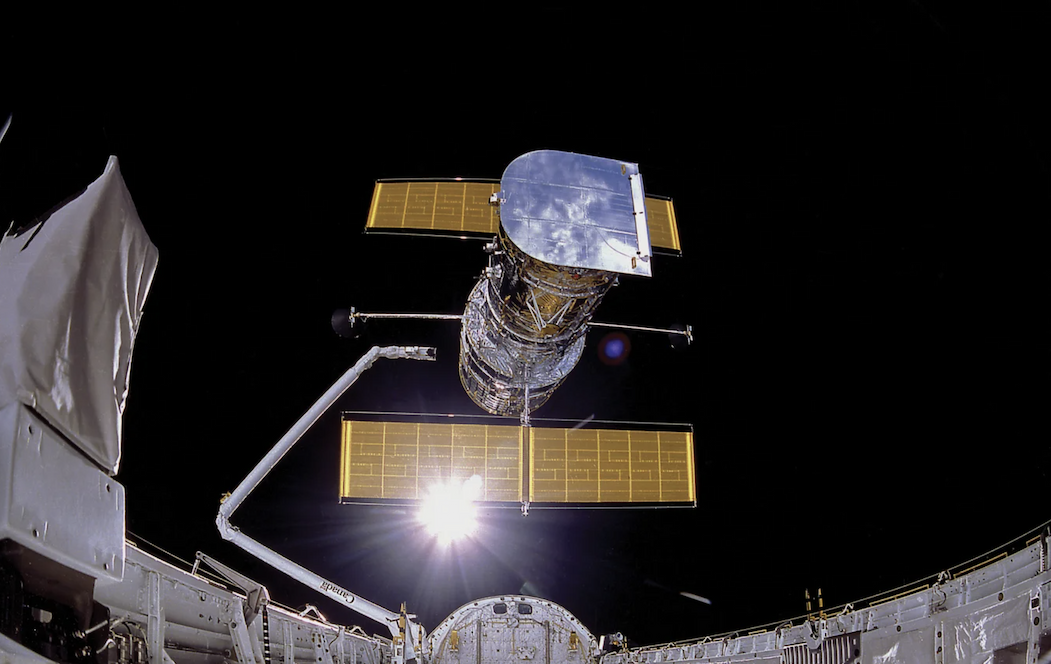
The Hubble Space Telescope. NASA
|
|
Hubble is Old, Still Great
In 1990, NASA launched the Hubble Space Telescope, which captured clear photos of previously unknowable celestial bodies deep in space. Thirty-one years later, the James Webb Space Telescope (JWST) launched, revealing stunning, high-definition updates to Hubble’s photos from years before. But just because NASA has a fancy new toy doesn’t mean that our friend Hubble should be forgotten—it's irreplaceable.
Hubble’s legacy: Hubble saw objects fainter than had ever been observed before, like hordes of galaxies that astronomers couldn’t previously identify. The telescope homed in on the speed of universe expansion, watched weather changes on the outer planets, proved that every big galaxy has a supermassive black hole at its heart, and accomplished so many more groundbreaking feats they would be impossible to list. It wasn't all perfect though, the Hubble project went way over budget and started out with a flawed mirror that needed to be corrected in the years after launch.
Its ongoing importance: One key difference between Hubble and JWST is that they take in different wavelengths of light—visible light for Hubble and infrared light for JWST. So JWST can’t replace Hubble; they see different things. Plus, Hubble is still in the sky at this very moment, taking observations long after it was expected to expire in 2010. And if you’re being super technical, at their respective best, Hubble’s resolution beats JWST’s by a smidgen.
|
|
|
|
|
|
A SPECIAL EVENT BY SCIENTIFIC AMERICAN
|
|
What's a quantum computer good for anyway?
|
|
Quantum computing’s revolutionary potential is one of the most tantalizing prospects for technological breakthroughs in the 21st century. But what’s real, and what’s hype? In principle, quantum computers offer enormous performance boosts for certain applications in cryptography, telecommunications, materials science, and fundamental physics. In practice, such breakthroughs remain as yet unrealized. Join Scientific American editors Lee Billings, Clara Moskowitz and Eric Sullivan for an engaging discussion on the promise and peril of quantum computing.
|
|
|
|
|
Archaeologist Daniel Davenport and his team uncover the secrets, both ancient and modern, hidden in the Hin Nam No National Protected Area in southern Laos. The challenging terrain is pocked with craters left from bombings during the Vietnam War, and can become near impassable during months-long wet seasons. But “it’s a stunning beautiful landscape,” says Davenport, and home to a unique network of more than 220 kilometers of caves and underground rivers. “There are hundreds, possibly thousands of unexplored caves in the park,” Davenport says. “It’s an archaeologist’s dream.” Nature | 3 min read
|
|
Hubble was at one point our clearest eye into the universe, seeing past the distorting clouds in our atmosphere into the beyond. Enjoying space photography is a great way to connect with the universe at large, and recently I was reflecting on why it feels so good to look into the cosmos. I found a quote from the French philosopher Simone Weil that says it better than I ever could:
“We have before us every day the example of the universe, where an infinite number of independent mechanical actions work together to form an order that, through variations, remains fixed. So we love the beauty of the world, because we sense behind it the presence of something akin to the wisdom which we would like to possess to satisfy our desire for the good.”
|
|
—Emma Gometz, Newsletter Editor
|
|
|
|
|
Subscribe to this and all of our newsletters here.
|
|
|
|
|