It's not what you think, and could be downright bizarre ͏ ͏ ͏ ͏ ͏ ͏ ͏ ͏ ͏ ͏ ͏ ͏ ͏ ͏ ͏ ͏ ͏ ͏ ͏ ͏ ͏ ͏ ͏ ͏ ͏ ͏ ͏ ͏ ͏ ͏ ͏ ͏ ͏ ͏ ͏ ͏ ͏ ͏ ͏ ͏ ͏ ͏ ͏ ͏ ͏ ͏ ͏ ͏ ͏ ͏ ͏ ͏ ͏ ͏ ͏ ͏ ͏ ͏ ͏ ͏ ͏ ͏ ͏ ͏ ͏ ͏ ͏ ͏ ͏ ͏ ͏ ͏ ͏ ͏ ͏ ͏ ͏ ͏ ͏ ͏ ͏ ͏ ͏ ͏ ͏ ͏ ͏ ͏ ͏ ͏ ͏ ͏ ͏ ͏ ͏ ͏ ͏ ͏ ͏ ͏ ͏ ͏ ͏ ͏ ͏ ͏ ͏ ͏ ͏ ͏ ͏ ͏ ͏ ͏ ͏ ͏ ͏ ͏ ͏ ͏ ͏ ͏ ͏ ͏ ͏ ͏ ͏ ͏ ͏ ͏ ͏ ͏ ͏ ͏ ͏ ͏ ͏ ͏ ͏ ͏ ͏ ͏ ͏ ͏ ͏ ͏ ͏ ͏ ͏ ͏
May 26, 2026—Scientists are still trying to determine the shape of our universe. Plus, impressive climbing fish and mathematicians use the video game Minecraft to calculate the value of pi. Let's go!
—Andrea Gawrylewski
Chief Newsletter Editor
|
|
P.S. Know someone who’d love this newsletter? Forward it along! Every share helps grow our wonderfully curious community.
|
|
Thomas Fuller/SOPA Images/LightRocket via Getty Images
|
|
-
Mathematicians found a way to determine the value of the mathematical constant 3.14159... as accurately as possible within the Minecraft world (which is made entirely of cubes). | 5 min read
- Scientific American spoke with dermatology and cosmetic chemistry researchers about the science of sunscreen: how it works, how to use it properly, and how formulations in the U.S. could be improved. | 4 min read
- In an ocean census conducted over the course of 13 expeditions and other efforts between mid-2025 and mid-2026, scientists found 1,100 previously undiscovered creatures. | 2 min read
- A researcher made up a completely fake disease and posted "research" about it online to test whether AI would fall for it. I bet you can guess what happened. | 15 min podcast
- Most of Western Europe is sweltering under a "heat dome," with multiple countries breaking temperature records. | 2 min read
- China is growing artificial human embryos on its space station to study how microgravity affects human pregnancy. | 2 min read
- This start-up company wants to install a mini data center on the exterior of residential homes, drawing power from the home’s energy supply and earning the owners discounted electricity and Internet in exchange. | 5 min read
|
|
Tiny investment, enormous universe: subscribe to Scientific American for 90 days for just $1 and help keep this newsletter going.
|
|
|
The Shape of the Universe
|
What shape is the universe? From the vantage point of Earth, I think most people imagine the universe all around us spreading out in every direction. But it turns out that isn’t quite true.
How to figure this out:
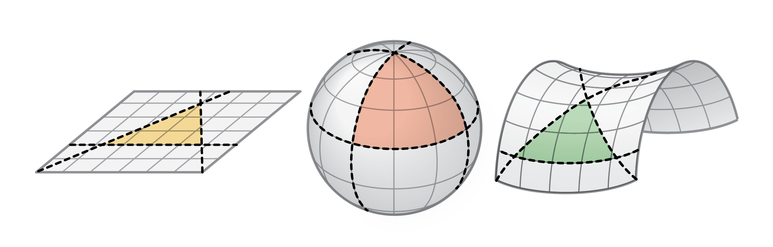
- The triangle method. In an early method for determining the shape of space, mathematicians plotted the distances between major landmarks (mountain peaks) and measured and compared angles of the triangles created between them. Depending on the curvature of space, the sum of the angles can vary. For example, the sum of the angles of a triangle is 180 degrees in a flat plane, but a sphere can have triangles with three right angles (totaling 270 degrees). Using this method, the scientists determined that space is flat.
But, the universe is too vast to measure triangles–stars within our own or in neighboring galaxies are too close to us to help us consider the vast scale of the universe. Furthermore, the objects we observe are moving and, because of gravity, that makes their light traveling to us follow partially curved paths.
|
|
Depending on the curvature of space, the sum of the angles of a triangle can be equal to (yellow), greater than (pink) or less than (green) 180 degrees. Amanda Montañez
|
|
- Measuring the earliest light. The first photons in the universe turned on around 370,000 years after the big bang. The so-called cosmic background radiation is relatively uniform no matter where we point our telescopes. But, small fluctuations in microwave radiation result from tiny density differences in that early glowing soup, and astronomers use these fluctuations to calculate the geometry of the universe. Since the density fluctuations correspond to our theoretical values, they suggest that our universe is flat.
So it’s flat, but what shape?
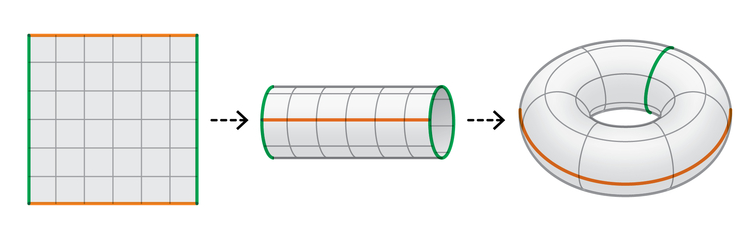
Curved 3D spaces are difficult to visualize, but if our universe were 2D and flat, most people would imagine a flat surface. But that’s not the only 2D shape with flat geometry. Another example is the surface of a torus, which resembles a bagel or donut. A torus is created by rolling flat material and then twisting the result into a ring.
|
|
You can imagine creating a torus from a flat material by rolling it so the ends meet and then twisting the resulting tube into a ring. Amanda Montañez
|
|
In 1934 mathematician Werner Nowacki proved that there are 18 different flat 3D shapes. If our universe is truly flat, then it has one of these 18 shapes. We can rule out some candidates because eight of the 18 are “nonorientable.” If you were to fly a rocket through a nonorientable universe, you would eventually return to your starting point, but in a mirrored form: your right would now be left, and vice versa. According to experts, such universes contradict the laws of physics.
Some remaining candidates:
- An infinitely extended 3D space with x, y and z axes.
- A 3D generalization of the torus: in this case, one can imagine gluing together the opposite faces of a cube.
- A half-twist torus: same as #2, but one pair of surfaces is twisted by 180 degrees, like a Möbius strip.
- A quarter-twist torus: same as #2, but a pair of surfaces is joined by twisting them by 90 degrees.
|
|
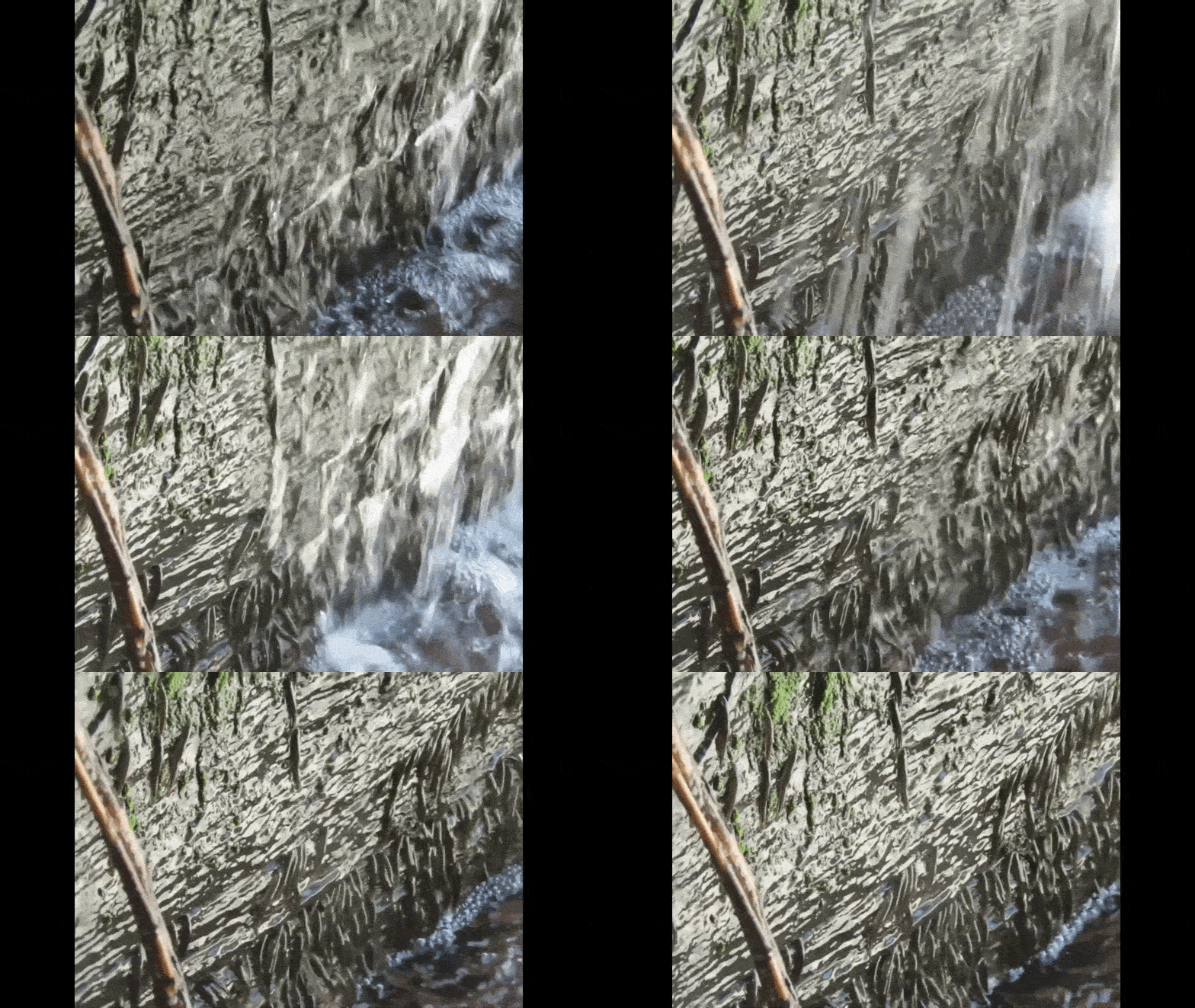
Shellear fish (Parakneria thysi) climb a waterfall in the Democratic Republic of the Congo. P. K. Mutambala and L. N. Kalumba
|
|
During major floods, thousands of tiny fish convene at Luvilombo Falls in the upper Congo River Basin to climb up a 50-foot waterfall. The behavior of this ziti noodle-sized species, called shellear, was described for the first time in Scientific Reports by an intrepid Ph.D. student who took a camera setup into the maw of a waterfall.
Why this is interesting: These tiny fish are scaling a vertical distance that is, proportional to their size, 50 percent taller than Honnold’s skyscraper in Taipei. And how do they do it if they don’t have arms? Their fins are covered with microscopic structures that resemble hooks, allowing them to have a grip on the slippery rock. They travel with bursts of upward motion, then take breaks that can last anywhere from under a minute to about an hour. In fact, most of their 10-hour journey is spent resting.
What the experts say: It’s “fabulous” to see a fish use “friction enhancers” like these hooks to cling and climb, says Adam Summers, a biologist at the University of Washington, who studies unusual adaptations in fish and wasn’t involved in the study. The climbing behavior of these fish was known anecdotally for years, but now it’s documented for the world. —Emma Gometz, newsletter editor
|
|
|
|
|
- Reassemble this image of our cover from the February 1927 issue. The cover shows greyhounds racing toward a mechanical rabbit. Such racing, called coursing, is one of the oldest sports, dating back more than 2,000 years; newer versions used a mechanical lure to increase the race’s speed and safety.
|
|
Why does it matter to scientists what shape the universe is? As Manon Bischoff writes, the topography of the universe was likely dictated by powerful forces interacting during the big bang. Imagine a loaf of bread coming out of the oven. Its shape, how much it has risen or not, or how crusty it is are all determined by conditions in the dough and oven where it bakes. Our universe, in its shape, preserves clues about how space expanded and the cosmos formed.
|
|
—Andrea Gawrylewski, Chief Newsletter Editor
|
|
|
|
|
Subscribe to this and all of our newsletters here.
|
|
|
|
|