OpenAI announces its AI has solved the Navier-Stokes equations ͏ ͏ ͏ ͏ ͏ ͏ ͏ ͏ ͏ ͏ ͏ ͏ ͏ ͏ ͏ ͏ ͏ ͏ ͏ ͏ ͏ ͏ ͏ ͏ ͏ ͏ ͏ ͏ ͏ ͏ ͏ ͏ ͏ ͏ ͏ ͏ ͏ ͏ ͏ ͏ ͏ ͏ ͏ ͏ ͏ ͏ ͏ ͏ ͏ ͏ ͏ ͏ ͏ ͏ ͏ ͏ ͏ ͏ ͏ ͏ ͏ ͏ ͏ ͏ ͏ ͏ ͏ ͏ ͏ ͏ ͏ ͏ ͏ ͏ ͏ ͏ ͏ ͏ ͏ ͏ ͏ ͏ ͏ ͏ ͏ ͏ ͏ ͏ ͏ ͏ ͏ ͏ ͏ ͏ ͏ ͏ ͏ ͏ ͏ ͏ ͏ ͏ ͏ ͏ ͏ ͏ ͏ ͏ ͏ ͏ ͏ ͏ ͏ ͏ ͏ ͏ ͏ ͏ ͏ ͏ ͏ ͏ ͏ ͏ ͏ ͏ ͏ ͏ ͏ ͏ ͏ ͏ ͏ ͏ ͏ ͏ ͏ ͏ ͏ ͏ ͏ ͏ ͏ ͏ ͏ ͏ ͏ ͏ ͏ ͏
September 8, 2026—Today OpenAI announced its AI had solved a million-dollar math problem. But is it legit? Plus, geologists discover the earthquake "stop sign signal", and defense companies are scrambling to be part of the Golden Dome.
—Andrea Gawrylewski,
Chief Newsletter Editor
|
|
Yuichiro Chino via Getty Images
|
|
Artificial intelligence has reportedly solved one of the six open “million-dollar” problems in mathematics, OpenAI announced today. The achievement proves that the equations that govern the motion of fluids are fundamentally flawed. | 5 min read
Prior to the announcement, rumors were circulating online among mathematicians over the proof’s origins—OpenAI has denied all allegations that it copied the method of another (human) mathematician. | 2 min read
For background: In recent months, mathematicians had been anticipating that AI might help researchers finally crack the equations that determine the flow of fluids. | 8 min read
In 2022, researchers detected a very odd photon from an enormous gamma ray burst that should have been destroyed on its way to Earth. But it wasn't—and now scientists know why. | 2 min read
Researchers found little change in brain gray matter volume during menopause, suggesting that sex hormone levels affect the brain in different ways at different times during the lifespan. | 2 min read
Google DeepMind released AlphaGenome Atlas, a database that charts predictions of the possible health effects of nine billion single variants in the human genome. | 3 min read
Music helps us recover from stress faster by strengthening specific neuronal pathways in the brain. | 2 min read
In order to support more than 1,000 space launches and reentries every year by 2030, the U.S. needs more spaceports. But how many is enough? | 6 min read
|
|
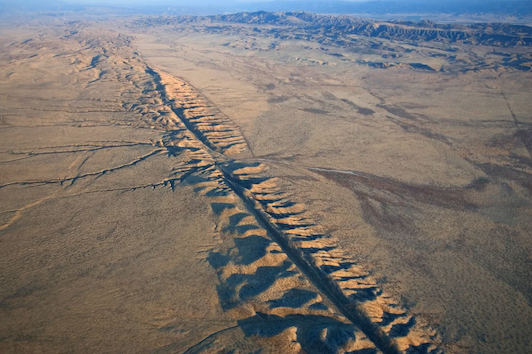
An aerial view of the San Andreas Fault crossing the Carrizo Plain in California. Cavan Images/Peter Essick/Getty Images
|
|
Seismic Stop Sign
When earthquakes start rumbling, what eventually stops them? An earthquake is a rupture on a fault line between tectonic plates, which spreads as seismic waves until it reaches an area of less stress or hits a physical barrier underground (like a change in the ground’s makeup or trapped high-pressure fluid). Researchers were able to identify the signature of an earthquake as it hit an underground barrier. To do so, they looked for a signal in the seismic and geodetic data registered by sensors in the direct paths of 12 large earthquakes across the globe. In the case of five of the earthquakes enough sensors were along the fault for that the team to see how the barriers stopped them.
Why this matters: Researchers were able to identify a “stopping phase” signature in an earthquake’s seismic data. Next, the researchers can pinpoint these phases in past earthquakes’ data to map out underground barriers and assess how much energy they can absorb. This could help geologists better predict earthquake hazards.
What the experts say: There’s a lot of work to do before the new findings help to build more accurate earthquake models, experts say. But the research “demonstrates the extremely valuable role of near-field observations in understanding why earthquakes grow big or remain small,” says Yihe Huang, a geophysicist at the University of Michigan, who was not involved in the study. —Emma Gometz, Newsletter Editor
|
|
Golden Dome Scramble
Though much of the technology that would make up President Trump’s “Golden Dome” to protect the U.S. from missile attacks already exists, at the moment there isn’t a firm plan for how to link it all together into a cohesive system. The basic premise is to create a network of satellites that can spot foreign missiles heading to the U.S., then send a signal to missile launchers that can intercept them (read: blow them up) before they reach the ground. Several defense companies are hoping to be key players when the plans become a reality (if ever).
The hurdles: Space-based interceptors require an unprecedented increase in scale. A threatening missile could theoretically launch from anywhere in the world, which means Golden Dome would need enough orbital interceptors to cover possible launch points around the planet—ideally with more than one shot at each threat. One analysis suggested it would take approximately 1,900 interceptors, and that’s just the bare minimum. An orbital system means more chances for space-based attacks from hostile nations and accidental collisions, both of which would create space debris that could take out other important satellites or fall back to Earth.
What the experts say: A set of 12 companies has been awarded funds to meet those challenges, and it wasn’t only the usual suspects like Lockheed Martin and Northrop Grumman. “Smaller, new space actors,” are trying to get in on the action, says Victoria Samson, chief director of space security and stability at the Secure World Foundation. “Basically everyone’s scrambling to get a piece of Golden Dome funding,” she says. —EG
|
|
|
|
|
This newsletter is powered by caffeine, existential curiosity and subscribers to Scientific American. Join us: 90 days for just $1.
|
|
I think you'd be safe to argue that in no other research arena has AI had a bigger impact than in math. It seems every week we report that AI has solved yet another mathematical mystery that had been sitting dormant for decades (here, here, here). I can imagine that mathematicians working in the field must be experiencing a degree of head spin with the relentless advancements. Yes, the pace of progress is marvelous. But that pace is far from normal and therefore feels unnatural.
|
|
Let me know what you think of this, and send any other comments or feedback on this newsletter to: newsletters@sciam.com. See you tomorrow!
—Andrea Gawrylewski,
Chief Newsletter Editor
|
|
|
|
|
Subscribe to this and all of our newsletters here.
|
|
Scientific American
1000 N West Street, Suite 1200
|
|
|
|
|