Drone warfare is ubiquitous ͏ ͏ ͏ ͏ ͏ ͏ ͏ ͏ ͏ ͏ ͏ ͏ ͏ ͏ ͏ ͏ ͏ ͏ ͏ ͏ ͏ ͏ ͏ ͏ ͏ ͏ ͏ ͏ ͏ ͏ ͏ ͏ ͏ ͏ ͏ ͏ ͏ ͏ ͏ ͏ ͏ ͏ ͏ ͏ ͏ ͏ ͏ ͏ ͏ ͏ ͏ ͏ ͏ ͏ ͏ ͏ ͏ ͏ ͏ ͏ ͏ ͏ ͏ ͏ ͏ ͏ ͏ ͏ ͏ ͏ ͏ ͏ ͏ ͏ ͏ ͏ ͏ ͏ ͏ ͏ ͏ ͏ ͏ ͏ ͏ ͏ ͏ ͏ ͏ ͏ ͏ ͏ ͏ ͏ ͏ ͏ ͏ ͏ ͏ ͏ ͏ ͏ ͏ ͏ ͏ ͏ ͏ ͏ ͏ ͏ ͏ ͏ ͏ ͏ ͏ ͏ ͏ ͏ ͏ ͏ ͏ ͏ ͏ ͏ ͏ ͏ ͏ ͏ ͏ ͏ ͏ ͏ ͏ ͏ ͏ ͏ ͏ ͏ ͏ ͏ ͏ ͏ ͏ ͏ ͏ ͏ ͏ ͏ ͏ ͏
September 28, 2026—Drones are ubiquitous and the U.S. is developing technology to fend off hostile ones. Plus, avocado trees switch sexes daily and SpaceX's Starship achieves an important milestone. Monday, let's go!
—Andrea Gawrylewski,
Chief Newsletter Editor
|
|
Starship launches on its 14th test flight. SpaceX screenshot
|
|
SpaceX’s Starship successfully launched this morning and, for the first time, propelled itself into orbit around Earth. A little over an hour and a half into the flight, SpaceX made the call to bring Starship back to Earth early. | 5 min read
Physicists at the Relativistic Heavy Ion Collider on Long Island found a surprising signal in primordial matter that mimics the universe just after the big bang. | 3 min read
The Trump administration announced plans to roll back fuel regulations, lowering the number of miles per gallon cars must achieve. It could be a disaster for the environment, experts say. | 2 min read
Transplanted hearts in both mice and humans show that they take on the age of their new bodies: young hearts showed signs of accelerated aging in older bodies, while older hearts in younger bodies seemed rejuvenated. | 4 min read
Antibodies made by the immune system can sometimes target human brain cells, causing psychiatric symptoms like hallucinations and other signs of psychosis. | 12 min read
|
|
Sky Weapons Defense
Drones have become a central feature in war. Drones make it possible to attack much more cheaply and at much greater scale—for instance, Iran has used drones to attack maritime traffic in the Strait of Hormuz, and Ukraine uses drones to coordinate attacks deep within Russian borders. Drones can gather intelligence on troop movements and strike those troops. They’re also a threat inside the U.S: anyone can buy them online and send them toward a military base or large gathering. But traditional U.S. defenses do not always match the threat.
-
Lasers. So-called directed energy can burn through drones’ hardware. Engineers have had to ruggedize them without disrupting the optics and power systems that make them work, then mount them on, say, tanks instead of keeping them in the laboratory.
-
Microwaves. Unlike a laser, a microwave weapon can spread its effects across a wider patch of sky. And they can fry drone electronics in milliseconds. For example, in August 2025, one weapons system called Leonidas defeated a swarm of 49 drones with a single pulse. The aircraft dotting the sky simply stopped and fell nearly in unison, like dancers dropping on cue. Using such power presents major challenges for any friendly electronics near the target, so engineers must find the balance between power and effectiveness.
What the experts say: Drones require a layered defense, an onion of options—kinetic and directed energy, long range and close-in, things that melt, burn or scramble electronics. “Small unmanned systems are a defining threat for our time,” says Army Lt. Col. Adam Scher, a spokesperson for an army-led task force on countering drone weapons.
|
|
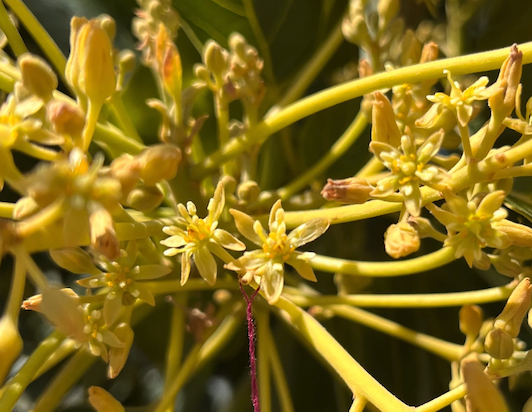
Avocado flowers in male and female phases. Flowers at left are recently opened male-phase flowers about to shed pollen. Flowers at right are female flowers just beginning to close. Jeffrey Scott Groh
|
|
Sex-Changing Avocados
Every spring, avocado trees change sex daily. A-type avocado trees begin with flowers in the female phase (receptive to pollen) in the morning and change to the male phase (producing pollen) in the afternoon of the next day. B-type trees are the reverse: male in the morning and female the next afternoon. Researchers pinpointed a single protein-coding gene that lets A- and B-type trees inherit the sex-swapping behavior. The protein it produces activates a host of additional genes to coordinate flowers opening and closing in rhythm to aid the trees’ reproductive strategy, letting the whole tree pulse from one sex to another.
Why this is interesting: Although this phenomenon has been known since 1927, the mechanism behind it has been a mystery until now. Only recently have tools to investigate this level of detailed genetic information become available and inexpensive enough for wider use. The genetic evidence suggests avocados’ ancestors picked up the sex-changing skill about 40 million years ago, and it most likely evolved separately multiple times in angiosperms (flowering plants).
What the experts say: “Through the power of genetics,” says Jeffrey S. Groh, a postdoctoral researcher at the University of California, Berkeley, “we can detect traces of this rhythm far into the ancient past, a humbling reminder that our own experience of this beautiful phenomenon is just a tiny sliver of its evolutionary history.” —Emma Gometz, Newsletter Editor
|
|
|
|
|
|
AN EXCLUSIVE EVENT FOR SCIENTIFIC AMERICAN SUBSCRIBERS
|
|
Some scientific questions aren’t just unanswered, but may even be unanswerable. We can never gather evidence from before the big bang, for instance, or the era when the first spark of life on Earth ignited. We may never know how long the human lifespan can be extended, or what consciousness is. Nevertheless, researchers will keep searching. Join Scientific American editors Seth Fletcher, Allison Parshall and Clara Moskowitz for a virtual discussion of these mysteries, which are at the center of our October issue’s special package: Impossible Questions.
|
|
|
|
|
Once viewed as harmless nerds, men in tech now suffer from an image problem and no one wants to date them. | WIRED
Last week at the U.N., Nepal's leader said recent floods serve as a "warning to the world" about climate change: “We did not create this crisis, yet we are paying a colossal price for it.” | NBC News
A piece of an 1880s shipwreck washed up onto a beach in Nantucket during the weekend's Nor'easter. | The New York Times ($)
|
|
Tiny investment, enormous universe: subscribe to Scientific American for 90 days for just $1 and help keep this newsletter going.
|
|
Flowering plants have devised some of the most extraordinary tactics to ensure they reproduce. Take the flower of the orchid Ophrys sphegodes, which grows to look like a female bee in order to attract male pollinators. Or the gargantuan corpse flower that emits a rotten-meat stench and heats itself up to help disperse the odor to attract flies, beetles and other carrion-consuming critters. And in a remarkable case of mutual benefit, the flowers of fig trees (ficus) serve as a nursery where female fig wasps lay their eggs; the next generation of bugs then feeds on the flower, mates inside the flower and the females fly off to pollinate another fig. I could write a daily newsletter filled with examples of wild adaptations of angiosperms for years and never run out of material. Perhaps I'd title it ... Flowers Gone Wild?
|
|
What's your favorite flower adaptation? And send any other comments or feedback on this newsletter to: newsletters@sciam.com. See you tomorrow!
—Andrea Gawrylewski,
Chief Newsletter Editor
|
|
|
|
|
Subscribe to this and all of our newsletters here.
|
|
Scientific American
1000 N West Street, Suite 1200
|
|
|
|
|