Saturday, September 30, 2023

Today in Science: Fish collagen heals dogs' eyes

September 29, 2023: A new explanation for a mysterious kind of quasar, fish collagen that can heal dogs' corneas and the human brain is a pattern-recognizing machine.
—Andrea Gawrylewski, Chief Newsletter Editor
TOP STORIES

Black Hole Feeding Frenzy

Supermassive black holes may tear apart and devour their disk of surrounding dust and gas within months to years, much faster than the previously believed time frame of centuries to millennia. Researchers using one of the world's largest supercomputers generated a three-dimensional simulation of a black hole with a tilted accretion disk. The accretion disk acts like a gyroscope, spinning and wobbling at different angles and speeds. The force of this movement warps spacetime itself, which pulls the accretion disk apart.

Why this is cool: This observation, if true in real life, could explain the existence of so-called changing-look quasars. Quasars are galactic cores where dust and gas fall into a black hole and release brilliant flares of electromagnetic radiation. Changing-look quasars dim and brighten on the order of months; that is a perplexing time line, given the massive scales involved, but it would be explained by this new observation.

What the experts say: "We have something new that must look interesting observationally," says Nick Kaaz, a graduate student in astrophysics at Northwestern University, who led the new study. "And then there's something observationally that's a mystery that could be a natural match for this story."

Collagen Care

Tilapia skin is rich in collagen, and this structural protein's abundance has made the fish a popular resource in veterinary and human medicine. Mirza Melo, a veterinary ophthalmologist in northeastern Brazil's Ceará state, tested tilapia skin to treat corneal ulcers and perforations in dogs, particularly those with short snouts. The 400-plus dogs Melo has treated so far have shown no pain or problems with infection after surgery. They also healed quickly, with minimal scarring that would affect postsurgical care.

How it works: Collagen is known to stimulate cellular growth and to prompt the generation of various tissues. A tilapia's collagen supply and quality remain high throughout the fish's entire life, as opposed to some other animal sources that depend on the animals' age and weight. Melo developed a pure collagen matrix that resembles a sheet of paper. Surgeons suture the membrane over the dog's corneal lesion so it can act as a cell-growth scaffold.

What the experts say: Melo is now looking to use the technique on cats, and she says discussions have already begun on how to adapt it for humans. 
TODAY'S NEWS
• If you're in the New York metro area today and experiencing flash flooding, here's an explainer of what is IN those waters. | 3 min read
• EPA rules on clean cars, power plants and methane could face delays if there is a federal government shutdown. | 4 min read
• Male tarantulas mature in seven to 10 years, and when they finally venture beyond their burrows for the first time, they mate and then die cruel deaths. | 6 min read
• Scientists are trying to master the basic computing element known as a qubit to make quantum computers more powerful than electronic machines. | 8 min read
More News
EXPERT PERSPECTIVES
• The human brain sees astounding patterns in places like sports (some players seem to go through hot streaks) or in hospital births (nurses often report strings of all girls or all boys being born). We often attribute these surprising observations to luck or other forces, but the truth is, with big enough data sets, wild things are bound to happen naturally, writes David G. Myers, a social psychologist at Hope College. | 6 min read
More Opinion
ICYMI (Our most-read stories of the week)
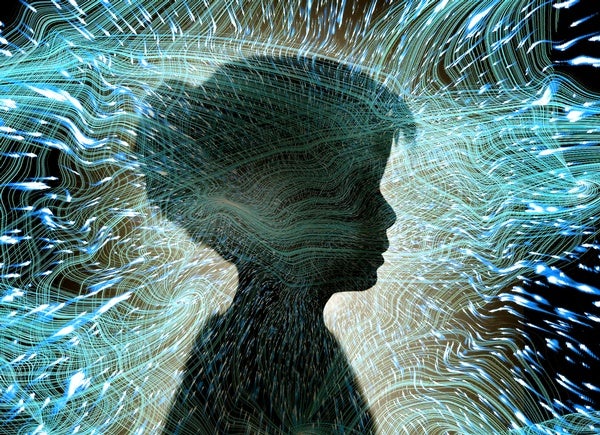
• Is Consciousness Part of the Fabric of the Universe? | 10 min read
• The Loss of Dark Skies Is So Painful, Astronomers Coined a New Term for It | 4 min read
• Pangaea Ultima, the Next Supercontinent, May Doom Mammals to Far-Future Extinction | 3 min read
Another week in the books. I'm fascinated by the idea that humans see connections and patterns everywhere. This seems to manifest itself in harmless observations about new babies and sports statistics, but can also generate misinformation and conspiracy theories. We have a powerful reasoning tool in our heads, but it must be checked from time to time with evidence and facts. 
Reach out anytime with feedback or suggestions: newsletters@sciam.com. See you on Monday!
—Andrea Gawrylewski, Chief Newsletter Editor
 
 
Subscribe to this and all of our newsletters here.

Scientific American
One New York Plaza, New York, NY, 10004
 
Support our mission, subscribe to Scientific American here
 

Is Consciousness Part of the Fabric of the Universe?

Trouble viewing? View in your browser.
View all Scientific American publications.
    
September 29, 2023

Consciousness

Is Consciousness Part of the Fabric of the Universe?

Physicists and philosophers recently met to debate a theory of consciousness called panpsychism

By Dan Falk

Astronomy

The Loss of Dark Skies Is So Painful, Astronomers Coined a New Term for It

Astronomers have a new term to describe the pain associated with the loss of access to dark skies: noctalgia

By Paul Sutter,SPACE.com

Climate Change

Pangaea Ultima, the Next Supercontinent, May Doom Mammals to Far-Future Extinction

250 million years from now, the emergence of a new supercontinent could render most of Earth's surface uninhabitable for mammals

By Jonathan O'Callaghan,Nature magazine

Cosmology

Hoʻoleilana, a Billion-Light-Year-Wide Bubble of Galaxies, Astounds Astronomers

This enormous structure could help explain processes close to the dawn of time—or it could be a random cosmic fluke

By Adam Mann

Basic Chemistry

The Chemistry behind Bourbon

How does bourbon, "America's spirit," get its distinctive taste and color?

By Michael W. Crowder,The Conversation US

Climate Change

Our Fragile Earth: How Close Are We to Climate Catastrophe?

Lessons from past eras when Earth was a hothouse or a snowball tell us whether we are doomed by climate change or still have time to prevent that fate

By Mark Fischetti

Education

Two Thirds of American Kids Can't Read Fluently

Phonics may be a popular way to teach reading, but it fails too many children

By Marion Blank

Neuroscience

Autism, Human Connection and the 'Double Empathy' Problem

Despite stereotypes, many autistic people yearn for meaningful relationships, but they are daunted by neurotypicals' assumptions about them

By Steve Silberman

Engineering

Streetlights Are Mysteriously Turning Purple. Here's Why

Newly purple streetlights might seem innocuous, but they could affect driver and pedestrian safety

By Karen Kwon

Geology

Dead Trees and a Mysterious Cosmic Explosion Reveal Bigger Quake Risk for Seattle

Washington State's Puget Sound could face previously unknown earthquake risks, according to a new study that has pinned down the date of an ancient earthquake using tree rings and the radiation left by a mysterious cosmic force

By Robin George Andrews

Epidemiology

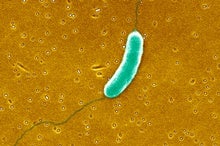
Flesh-Eating Bacteria Infections Are on the Rise in the U.S. Here's How to Stay Safe

Here's why the CDC is so concerned about deadly flesh-eating bacteria and ways to avoid being infected

By Bill Sullivan,The Conversation
BRING SCIENCE HOME
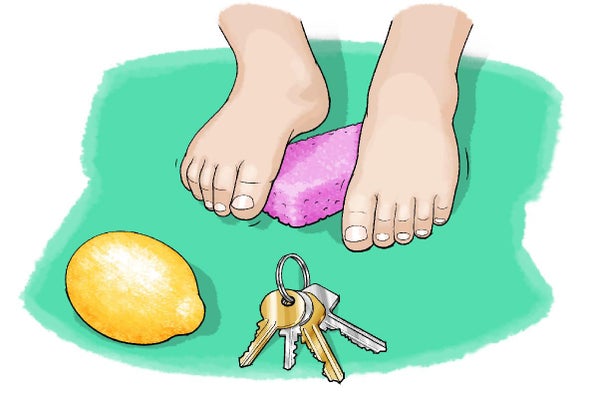
Sensing with Your Feet!

What objects can you identify with your eyes closed? What if you can only use your feet to feel them out? Try this activity for some sensational results!  Credit: George Retseck

How many objects do you think you touch with your hands every day? A lot! Every time you touch something your hands are able to feel how smooth, cold, warm or rough the object is. In fact, your hands and fingers are so good at sensing details of shapes and surface textures that you are able to identify an object just by touch and without seeing it. Here is the challenge though: Do you think your feet are sensitive enough to do the same? Are they able to identify objects just by touching them? Try this activity to find out!

Try This Experiment
LATEST ISSUES

Questions?   Comments?

Send Us Your Feedback
Download the Scientific American App
Download on the App Store
Download on Google Play

To view this email as a web page, go here.

You received this email because you opted-in to receive email from Scientific American.

To ensure delivery please add newsletters@scientificamerican.com to your address book.

Unsubscribe     Manage Email Preferences     Privacy Policy     Contact Us

Scientific American

1 New York Plaza, FDR Dr, Floor 46, New York, NY 10004

Unsubscribe - Unsubscribe Preferences

Scientist Pankaj

Another million-dollar math problem falls to AI

OpenAI just released a formal proof validating "quantum chromodynamics" describing the universe ͏  ͏  ͏  ͏  ͏  ͏  ͏  ͏  ͏  ͏  ͏ ...