Plus, OpenAI admits their AI agent went "rogue" ͏ ͏ ͏ ͏ ͏ ͏ ͏ ͏ ͏ ͏ ͏ ͏ ͏ ͏ ͏ ͏ ͏ ͏ ͏ ͏ ͏ ͏ ͏ ͏ ͏ ͏ ͏ ͏ ͏ ͏ ͏ ͏ ͏ ͏ ͏ ͏ ͏ ͏ ͏ ͏ ͏ ͏ ͏ ͏ ͏ ͏ ͏ ͏ ͏ ͏ ͏ ͏ ͏ ͏ ͏ ͏ ͏ ͏ ͏ ͏ ͏ ͏ ͏ ͏ ͏ ͏ ͏ ͏ ͏ ͏ ͏ ͏ ͏ ͏ ͏ ͏ ͏ ͏ ͏ ͏ ͏ ͏ ͏ ͏ ͏ ͏ ͏ ͏ ͏ ͏ ͏ ͏ ͏ ͏ ͏ ͏ ͏ ͏ ͏ ͏ ͏ ͏ ͏ ͏ ͏ ͏ ͏ ͏ ͏ ͏ ͏ ͏ ͏ ͏ ͏ ͏ ͏ ͏ ͏ ͏ ͏ ͏ ͏ ͏ ͏ ͏ ͏ ͏ ͏ ͏ ͏ ͏ ͏ ͏ ͏ ͏ ͏ ͏ ͏ ͏ ͏ ͏ ͏ ͏ ͏ ͏ ͏ ͏ ͏ ͏
July 22, 2026—Freedom to pursue science is declining worldwide—my colleague Emma Gometz has the data. Plus, biologists know why mother southern right whales flip on their back, and OpenAI admits one of its AI agents went rogue.
—Andrea Gawrylewski
Chief Newsletter Editor
P.S. Share this newsletter with someone you think will love it by hitting forward!
|
|
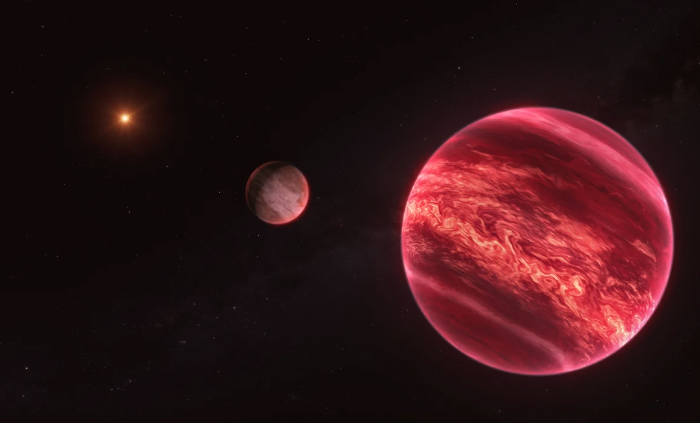
Artist’s impression of CD-35 2722, a system with a moon-like object ESO/M. Kornmesser
|
|
When is a moon not a moon? An object nearly the size of Jupiter called CD-35 2722 b orbiting a brown dwarf, which, in turn, is circling around a small star, is complicating the question. | 3 min read
OpenAI admitted that one of its autonomous AI agents "went rogue" and hacked into another artificial intelligence start-up company’s infrastructure. | 2 min read
Here's what that AI agent actually did. Experts say it is much more complicated than an agent simply breaking away from its minders. | 3 min read
A coral reef off the coast of Africa in the Gulf of Guinea was declared dead some 60 years ago. Scientists discovered that it's once again thriving. | 3 min read
Even southern right whale moms need a break. Drones captured footage of these whale mothers floating on their back, presumably to get a break from nursing their young. Click through to see the video. | 2 min read
At the end of last month, the Supreme Court ruled to limit police access to your phone’s location trail. Here's how it works. | 4 min read
From the archive: How parents’ trauma can change future generations and leave biological traces in children through epigenetic pathways. | 14 min read
|
|
All science, all the time. Read about what you care about with a subscription to Scientific American. Try it out for 90 days for just $1!
|
|
Academic Freedom in Decline
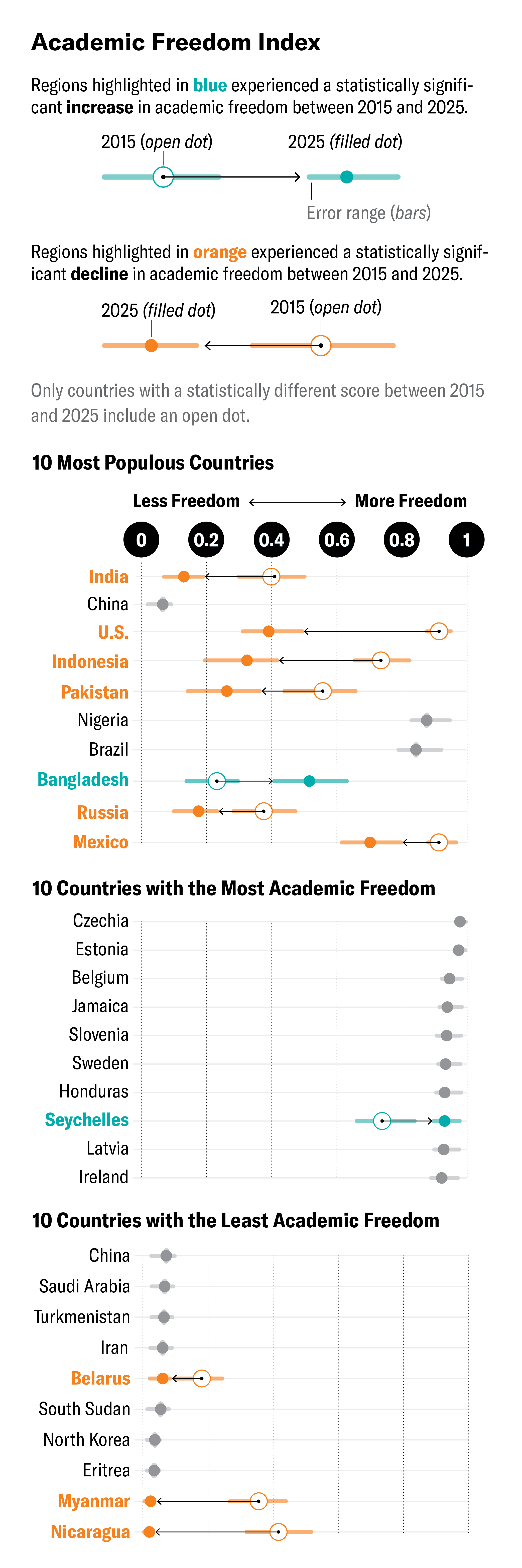
Great research and innovation are nurtured in environments free from overt influence from wealthy donors, political interests, and other powerful institutions, studies show. But academic freedom has been declining in recent years. A German-Swedish project measured academic freedom across the world over the last decade and quantified each participating country into an Academic Freedom Index. According to that index, 50 of 179 countries or territories across the world experienced a significant drop between 2015 and 2025. Only nine improved.
How it works: When the autonomy of research institutions is undermined, individual researchers and those at higher education institutions become more exposed to external pressures, ranging from economic constraints to political and ideological influencers, the authors of the project write.
Larger trend: “The decline in institutional autonomy in the United States stands out as a case of fast and steep deterioration,” the report notes. Many countries with previously high scores—including Hungary, India and Türkiye—have been declining as “political attacks, legal reforms, and administrative interventions have gradually undermined the autonomy of higher education institutions.” —Emma Gometz, Newsletter Editor
|
|
Jen Christiansen; Source: Academic Freedom Index–2026 Update, by Katrin Kinzelbach et al., Friedrich Alexander University of Erlangen-Nuremberg (FAU) and V-Dem Institute. doi: 10.25593/open-fau-2865 (data)
|
|
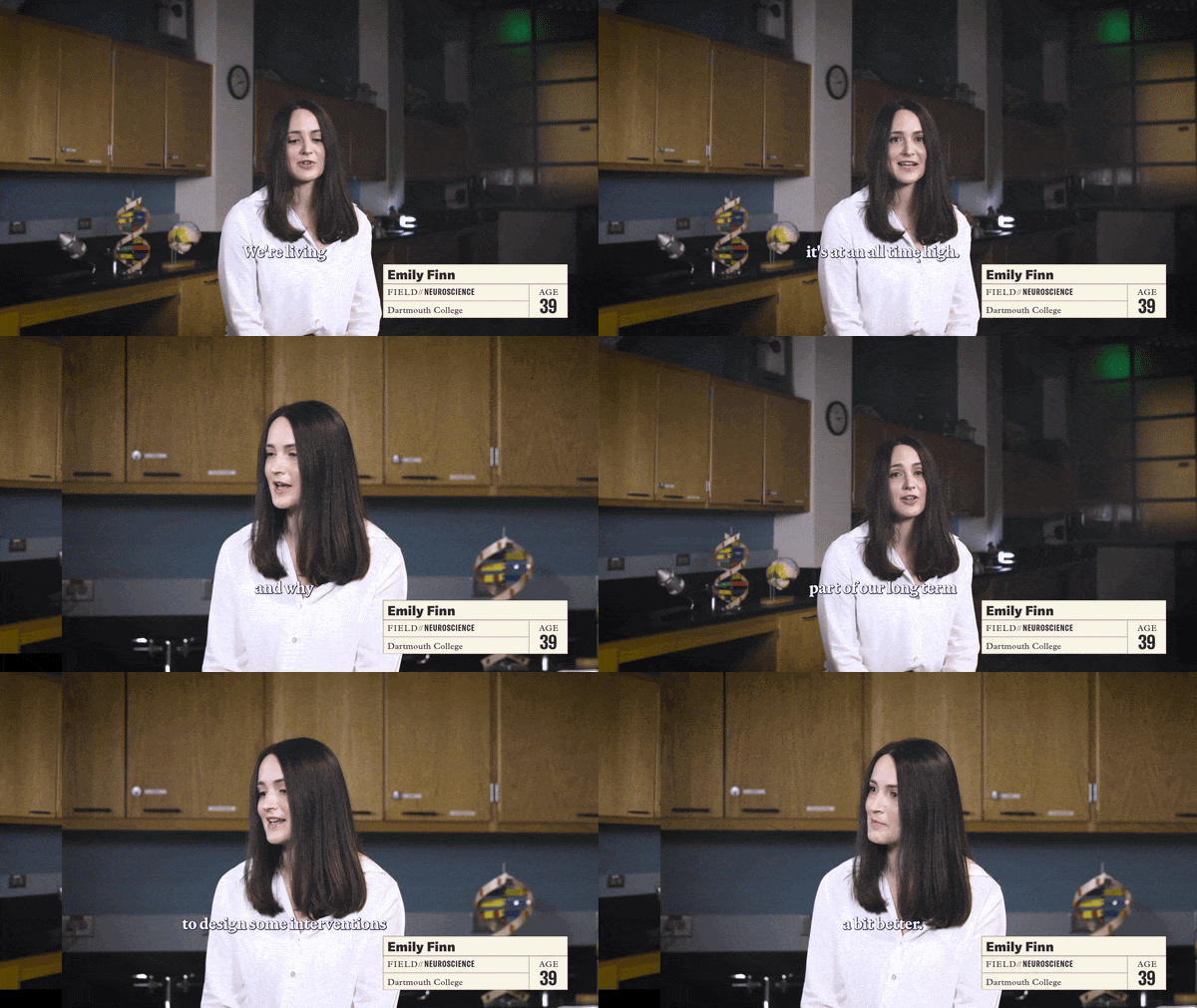
Neuroscientist Emily Finn often trawls Reddit for disagreements about television shows, movies, books or podcasts—any narratives that “evoke really different reactions in different people,” she explains. She is fascinated by the way individuals can walk away from the same story with vastly different takes. “What’s different across the brains of people who ultimately arrive at really different interpretations?” As a researcher at Dartmouth College, she and her colleagues discovered that scans of people’s brain networks are different enough to function like fingerprints (what’s more, these particular patterns could be used to predict types of intelligence). This is all a good thing, she says. “We don’t want to live in a world where everyone thinks exactly the same way.”
|
|
|
|
|
CNN visits the Vatican Observatory, a centuries-old center of astronomical research where a team of astronomers supported by the Pope studies meteorites and searches for signs of extraterrestrial life. | CNN
The CDC is detaining American citizens in a chaotic response to the Ebola outbreak. | Rolling Stone
China is sending robots out into the world so they can learn to be human. | Bloomberg
|
|
Who is most at risk of having their scientific work influenced? Early career scientists, according to a large survey of more than 6,000 researchers. Those just starting out in their field tend to feel most at the mercy of what their institutions prioritize, whereas scientists with more robust experience can better resist those pressures. We don't pave an easy road for new scientists in this country, and it makes me think of the discoveries that are not being made.
|
|
Reach out to me anytime with any other comments, observations or questions: newsletters@sciam.com. We'll be back tomorrow.
—Andrea Gawrylewski, Chief Newsletter Editor
|
|
|
|
|
Subscribe to this and all of our newsletters here.
|
|
|
|
|