Here's what scientists are planning for next month's total solar eclipse. ͏ ͏ ͏ ͏ ͏ ͏ ͏ ͏ ͏ ͏ ͏ ͏ ͏ ͏ ͏ ͏ ͏ ͏ ͏ ͏ ͏ ͏ ͏ ͏ ͏ ͏ ͏ ͏ ͏ ͏ ͏ ͏ ͏ ͏ ͏ ͏ ͏ ͏ ͏ ͏ ͏ ͏ ͏ ͏ ͏ ͏ ͏ ͏ ͏ ͏ ͏ ͏ ͏ ͏ ͏ ͏ ͏ ͏ ͏ ͏ ͏ ͏ ͏ ͏ ͏ ͏ ͏ ͏ ͏ ͏ ͏ ͏ ͏ ͏ ͏ ͏ ͏ ͏ ͏ ͏ ͏ ͏ ͏ ͏ ͏ ͏ ͏ ͏ ͏ ͏ ͏ ͏ ͏ ͏ ͏ ͏ ͏ ͏ ͏ ͏ ͏ ͏ ͏ ͏ ͏ ͏ ͏ ͏ ͏ ͏ ͏ ͏ ͏ ͏ ͏ ͏ ͏ ͏ ͏ ͏ ͏ ͏ ͏ ͏ ͏ ͏ ͏ ͏ ͏ ͏ ͏ ͏ ͏ ͏ ͏ ͏ ͏ ͏ ͏ ͏ ͏ ͏ ͏ ͏ ͏ ͏ ͏ ͏ ͏ ͏
July 15, 2026—Scientists have big plans to gather data during the August 12 solar eclipse. Plus, robots might soon be doing your chores, and cyclosporiasis infections are booming.
—Andrea Gawrylewski
Chief Newsletter Editor
|
|
A new breakthrough gets mathematicians one step closer to understanding how much order exists inside chaos. | 5 min read
Cases of cyclosporiasis are surging. Here's the latest and what you can do to avoid getting sick. | 2 min read
Trump’s latest pick to lead the CDC, Erica Schwartz, a former deputy surgeon general, stated that she will "never betray the science" at a Senate confirmation hearing today. | 2 min read
Check out the first X-rays of humans in space. They were taken by the crew of the Fram2 mission, which was the first human spaceflight to enter a polar orbit. | 2 min read
Astronomers spotted the faintest exoplanet on record orbiting around the Beta Pictoris star system. | 3 min read
An experimental immune-cell therapy shows strong results in early trials against deadly brain and spinal cord cancers in children. | 3 min read
|
|
The moon passes in front of the sun during a solar eclipse on April 8, 2024, in Martin, Ohio. Gregory Shamus/Getty Images
|
|
Eclipse Science
On August 12 a total solar eclipse will be viewable in some parts of the world. The sky will darken and totality will occur for just two minutes and 18 seconds, at longest, across a swath that includes Greenland, Iceland and northern Spain. Scientists everywhere will be scrambling to gather as much data as they possibly can during those moments when the solar atmosphere is revealed. It’s a rare opportunity to learn about the physics of the sun, Earth’s atmosphere and even animal behavior.
Some of the science:
NASA will have three WB-57 high-altitude research planes flying at 50,000 feet over Iceland. Reaching speeds of around 470 miles per hour, the planes will gather data on the sun’s corona, or outermost layer, using cameras, which will capture images of our star’s fiery halo in visible, near-infrared and mid-infrared wavelengths of light.
Many balloons will be gathering data as well. One project called the Nationwide Eclipse Ballooning Project will deploy 80 balloons into the skies above both Spain and Iceland over the course of 30 hours. Some of the balloons will contain experiments looking for atmospheric gravity waves, which are essentially ripples of rising and sinking air in the atmosphere. These waves can cause undulating cloud patterns, as well as turbulence. They can also indicate extreme weather. Another set of balloons organized by a Spanish project will be launched almost 20 miles into the sky over Spain. Those balloons will be outfitted with instruments to measure atmospheric conditions, as well as a Geiger counter, a magnetometer and a device to count muons (elementary particles).
What the experts say: “It’s a rare opportunity to be able to see and measure the sun’s outer atmosphere, the solar corona,” says Amir Caspi, a solar physicist at the Southwest Research Institute, who is working on the NASA project. “The surface of the sun, the disk of the sun, is a million times brighter than the solar corona, at least in visible wavelengths. If you want to study and measure the solar corona, an eclipse gives you that opportunity by blocking out something that’s a billion times brighter.”
|
|
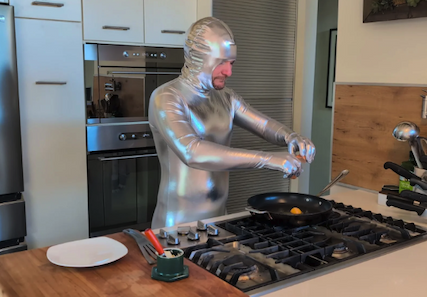
Dressed as a robot, Benjie Holson demonstrates the silver medal challenge in his proposed Humanoid Olympics: cook and plate a sunny-side up egg. Benjie Holson
|
|
Robots Can Fold Laundry
Why is this man dressed in a silver body suit making eggs? He’s helping set the standards for robots to one day do the same. Last September roboticist Benjie Holson of Robust AI started the “Humanoid Olympic Games,” a set of tests for humanoid robots’ ability to do chores, and he found that it took mere months for a separate San Francisco-based company to make a robot that could do 11 out of the 15 tasks he set. To demonstrate these tasks, Holson had to record himself doing them first.
Why this is interesting: A common refrain countering the merits of humanoid robots is that, although they can play sports and make faces, they still haven’t figured out how to do the things we really want, like wash dishes or fold laundry. The robots able to successfully do most of the tasks in Holson’s Olympics were 100-percent vision-based, meaning they didn’t need to use pressure-sensing tech to train their robotic dexterity; they relied instead on video demos like Holson’s.
What the experts say: The question on Holson’s mind is why cameras work so well for robots to judge things like distance and force. “Touch technology is way worse, more expensive, delicate and far behind cameras. We’ve been working on cameras for a long time,” says Holson. “It works way better than I expected.” —Emma Gometz, Newsletter Editor
|
|
Credit: Christie Hemm Klok; With special thanks to the Exploratorium, San Francisco, Calif.
|
|
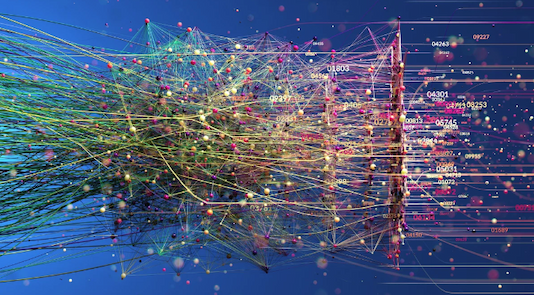
Christina V. Theodoris, a physician-scientist at Gladstone Institutes and the University of California, San Francisco, and her colleagues use AI to examine gene-activity data from millions of cells across a range of human tissues. They can identify which genes are responsible for launching specific diseases or conditions, work that she says would be infeasible without the AI tools. Her lab has identified the underlying pathways that lead to hardening and calcification of the valves in the heart, and they pinpointed a molecule that can stop and even reverse the disease progression. Theodoris estimates that in five to 10 years we will see amazing progress in using AI to identify the underlying genetic causes of disease and devising treatments for them.
|
|
|
|
|
How a gang of thieves stole millions of dollars in servers from a data center. | The New York Times
AI bots will enable a ramp-up of political text messages. Ugh. | NPR
The number of inpatient beds for psychiatric patients continues to fall. Here's one person's story of trying to find one. | KFF Health News
|
|
For me, the highlight of the total solar eclipse of 2024 was by FAR receiving so many photos taken by you, our science-loving readers. Dozens of you shared your experiences during the eclipse and sent along some dazzling photos. Let me know: Will you be traveling to see the solar eclipse in August? If so, keep me in mind and try to snap some good photos to share with this community. I must second the researcher quoted above and say that an eclipse is a remarkable natural event that we only get a few of (if any) in life!
|
|
Reach out to me anytime with any other comments, observations or questions: newsletters@sciam.com. We'll be back tomorrow.
—Andrea Gawrylewski, Chief Newsletter Editor
|
|
|
|
|
Subscribe to this and all of our newsletters here.
|
|
|
|
|