Construction is about to start on the Deep Synoptic Array in Nevada ͏ ͏ ͏ ͏ ͏ ͏ ͏ ͏ ͏ ͏ ͏ ͏ ͏ ͏ ͏ ͏ ͏ ͏ ͏ ͏ ͏ ͏ ͏ ͏ ͏ ͏ ͏ ͏ ͏ ͏ ͏ ͏ ͏ ͏ ͏ ͏ ͏ ͏ ͏ ͏ ͏ ͏ ͏ ͏ ͏ ͏ ͏ ͏ ͏ ͏ ͏ ͏ ͏ ͏ ͏ ͏ ͏ ͏ ͏ ͏ ͏ ͏ ͏ ͏ ͏ ͏ ͏ ͏ ͏ ͏ ͏ ͏ ͏ ͏ ͏ ͏ ͏ ͏ ͏ ͏ ͏ ͏ ͏ ͏ ͏ ͏ ͏ ͏ ͏ ͏ ͏ ͏ ͏ ͏ ͏ ͏ ͏ ͏ ͏ ͏ ͏ ͏ ͏ ͏ ͏ ͏ ͏ ͏ ͏ ͏ ͏ ͏ ͏ ͏ ͏ ͏ ͏ ͏ ͏ ͏ ͏ ͏ ͏ ͏ ͏ ͏ ͏ ͏ ͏ ͏ ͏ ͏ ͏ ͏ ͏ ͏ ͏ ͏ ͏ ͏ ͏ ͏ ͏ ͏ ͏ ͏ ͏ ͏ ͏ ͏
June 18, 2026—This isn't the first time the government has attacked U.S. science. Plus, construction on a new, hyper-sensitive telescope array is about to begin and we explore the surprising science of ticker tapes.
—Andrea Gawrylewski
Chief Newsletter Editor
|
|
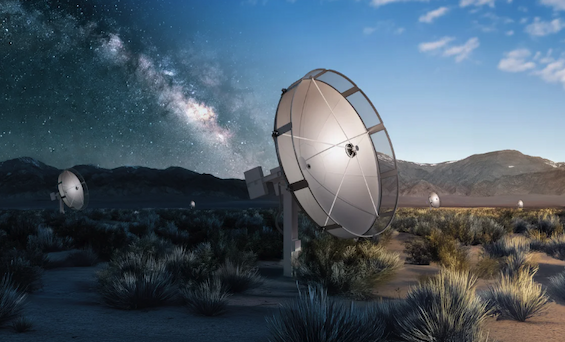
The Deep Synoptic Array will provide a new view of the Milky Way, as well as the distant universe. Caltech/K. Miller and A. Mejía
|
|
Construction of a new telescope, the Deep Synoptic Array, is about to start in rural Nevada. It will be the most sensitive radio telescope in history and used to gather data on galaxies, pulsars, the formations of stars and more. | 3 min read
This morning, Knicks fans flocked to Manhattan for a ticker-tape parade. This is the surprising science of ticker tape. | 3 min read
NASA is teaming up with private space company Relativity Space to place NASA’s Aeolus probe into orbit around Mars, with a launch currently targeted for sometime in 2028. | 2 min read
The Trump administration has backtracked on its effort to pull some 900 ocean-monitoring buoys and sensors out the water. The plan drew backlash from scientists and lawmakers. | 2 min read
As many as 77 percent of U.S. psychologists report that their patients are using AI for companionship or other mental health support. | 4 min read
On August 12, the moon will pass directly between the Earth and the sun, blocking its light over a swathe of western Europe and the Arctic. Even if you aren't in the path of totality, you can watch the eclipse with us. | 2 min read
Researchers discovered a veil of salty clouds on the surface of GJ504b, which astronomers nicknamed the "pink planet" for its deep cherry blossom hue, even though it's not really a planet at all. | 3 min read
|
|
Join a community of science loving readers with a subscription to Scientific American. Try it out for 90 days for just $1.
|
|
History Repeats Itself
This week, we’re examining the state of American science and celebrating some of the brilliant minds who will be forging a path of discovery, despite current setbacks. Many scientists have told us they feel extremely shaken by the drastic and arbitrary cuts and delays of funding for research in the last 18 months. But American science has faced similar challenges in our not-so-distant past. As science journalist Deborah Blum reports, many science historians see similarities between the eras of Donald Trump and Richard Nixon and the ways these presidents sowed distrust of science among Americans to push their agendas. Nixon imposed widespread cuts to research funding while redirecting money to his chosen science projects. The parallels don’t end there.
Antiscience sentiment: Nixon viewed many scientists as part of an academic establishment aligned with antiwar and environmental movements of the time. Despite having started the EPA in 1970, his administration redirected funding for science to defense programs. Nixon both leaned publicly into antiscience rhetoric and fostered it internally. He abolished the post of Presidential Science Adviser, the Office of Science and Technology and the President’s Science Advisory Committee and placed antiscience skeptics in positions of power in the administration.
Funding cuts: Nixon announced cross-agency budget cuts that would drastically reduce funding for training young scientists. To make up for an expensive foreign war in Vietnam, he targeted funding for basic research. Trump has gone much further, proposing sweeping cuts to research budgets, terminating grants, and creating uncertainty around billions of dollars in federal support for universities and laboratories.
Control over federal scientists: Nixon’s administration and the military arm thought science should produce more useful innovations for defense and be directly accountable to the executive branch. Meanwhile Trump has steered funding to research that supports his ideologies and pursued policies that would make it easier to remove career civil servants and replace them with political appointees.
Shrinking enterprise: By 1975—partly at the direction of the Nixon administration—federal funding for non-defense-related research had dropped by more than 20 percent since the high-water amounts of the 1960s. Today, the Trump administration has cut 7,800 grants and removed 25,000 scientists and related personnel from their jobs. Young scientists are considering going abroad for better, less uncertain research opportunities.
The way forward: In the administrations following Nixon, science regained both money and status, in part because of strategic advocacy by scientists. “Maybe this is a chance to rebuild research institutions that are more engaged with the public,” says Miles Arnett, a Ph.D. student studying cell regeneration in the human gut at the University of Pennsylvania. “Maybe it’s a chance for institutions to start including and rewarding good communication as part of scientific training.”
|
|
|
|
|
|
YOUNG AMERICAN SCIENTISTS
|
|
Jenny Bergner's astrochemistry lab at the University of California, Berkeley, studies the chemistry of planet formation. Her team combines telescope data with lab experiments that replicate severe conditions of deep space: The researchers place molecules in an ultracold, ultralow-pressure vacuum to form disordered, porous ices similar to those found in space and then bombard that ice with photons to mimic the radiation of interstellar space. “Then we can understand, at a molecular level, what reactions are taking place,” she says. These reactions could influence how planetary bodies form as their molecular components start to coagulate.
|
|
I was so lucky to be the one to interview Jenny Bergner for our Young American Scientists package. Dr. Bergner was thrust into a bit of limelight in 2023 when she and a colleague proposed an alternative explanation for the behavior of ‘Oumuamua, the first interstellar object ever observed passing through our solar system. Rather than attributing the movement of ‘Oumuamua to extraterrestrials or some other fantastical explanation, Bergner determined an answer based soundly in chemistry. The "magic" explanations out there were not very interesting to her, she told me. Using science to solve a problem is far more satisfying.
|
|
—Andrea Gawrylewski, Chief Newsletter Editor
P.S. If this newsletter sparked your curiosity today, consider forwarding it to a friend!
|
|
|
|
|
Subscribe to this and all of our newsletters here.
|
|
|
|
|