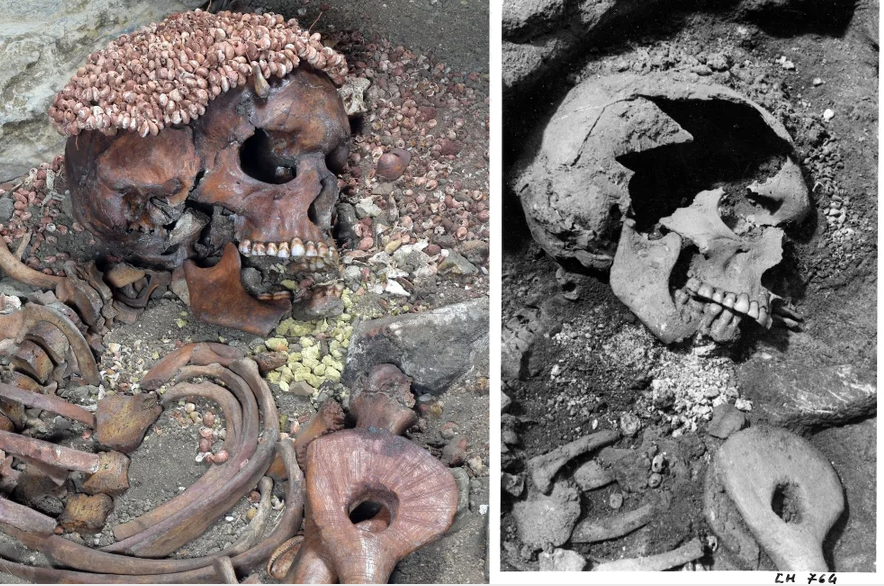
January 27, 2026—The science of why people interpret video footage so differently, how to send a message to future humanity and the next moon mission is proceeding. —Andrea Gawrylewski, Chief Newsletter Editor | | The teenager's head, showing trauma to the face, with a reconstructed cap of shells, as displayed today (left). The same area after excavation (right). Archives of the Soprintendenza Archeologia Belle Arti e Paesaggio per la Liguria; From Stefano Sparacello et al., in Journal of Anthropological Sciences, Vol. 103; 2025 | | -
The remains of a teenage boy who lived around 27,000 years ago suggest he was mauled by a cave bear—some of the first direct evidence of a predator attacking an ancient human. | 2 min read
- A "wet" dress rehearsal of the launch of the Artemis II moon mission is set to take place as soon as this coming Saturday. | 2 min read
- Brain scans from 10,873 people in the U.K. revealed that postmenopausal participants showed lower volumes of gray matter, potentially explaining why some women experience neurological symptoms such as anxiety, depression and memory problems. | 3 min read
- Physicists pushed the limits of Schrödinger's cat, placing clusters of 7,000 atoms of sodium metal some 8 nanometers wide into a superposition of different locations. | 4 min read
-
A scientist who helped eradicate smallpox, Willam Foege, died last weekend at age 89. | 2 min read - Babies who attend daycare develop greater diversity in their microbiomes, according to an analysis of baby-to-baby transmission of gut bacteria. | 4 min read
- For discussion: With the proliferation of digital deepfakes, we may soon live in a world where a new class of forensic experts must certify what's real and what's not. What do you think? Should we verify everything or trust what we see until something is proven false? Post your comments by reading the above article, scrolling down to the tan box and clicking "Join the Discussion."
| | Video footage figures heavily in modern news events. How can different people watch the same video footage and yet see such vastly different things? People tend to trust video footage, likely because the human brain is so attuned to visual information. And yet a host of neurological biases kick into gear when humans watch videos. "Seeing is not just what our eyes physically see," says Sandra Ristovska, an associate professor of media studies at the University of Colorado Boulder, "but also the experiences and ideas that viewers bring to images."
Confounding factors: - Slow motion bias. In one 2016 study, researchers showed that when viewers watched surveillance footage of a shooting in slow motion, they perceived the shooter as "more intentional." Similarly, if a video is shaky, viewers can interpret events as more intense.
- Camera perspective bias. In studies, participants viewed videos of people confessing to crimes. In some videos, the camera focused on a suspect's face, while in others, it focused on the interrogators. Viewers who saw videos centered on the suspects' face were more likely to perceive the confessions as "more voluntary."
- Memory contamination. If two people share memories of an incident, they might unwittingly adopt some of the memories of the other person as their own.
- Selective attention. If prompted to focus on a specific aspect of a video, viewers might miss other important details. People can also be primed to see what others want.
- Personal beliefs. A person's beliefs can shape their visual perception. For example, people who identify with law enforcement are more likely to perceive police officers as acting lawfully in video evidence than are people who don't identify with law enforcement.
What the experts say: "People intuitively tend to believe that video gives them the objective reality of what it depicts," says Neal Feigenson, a law professor at Quinnipiac University. "This is naive realism." | | Last fall, Scientific American assigned science journalist Peter Brannen an unusual assignment: Figure out how far into the future humans could send a time capsule on Earth. Where should it be buried to last the longest? What should the capsule be made of? How far into the future might it persist and be discovered?
The challenges: Earth is a very alive planet. Unlike Mars or even the moon, which still bears the mark on its surface of an asteroid impact some 4.3 billion years ago, Earth's tectonic plates constantly churn, lifting some parts of the planet up, and devouring others. This means sedimentary material is constantly eroded and transformed. For a chance to survive into the future, a time capsule would need to be buried in a sedimentary basin—a region that is sinking, where sediments can accumulate. Today only 16 percent of Earth's land surface is constituted of such sedimentary basins. Simultaneously, the capsule itself would need to be constructed of an erosion-resistant material. Experts advised Brannen that a laser-etched capsule of zircon has the best chance of long term survival. That is, assuming that humans are around to discover it. Pinpointing the best geographical location for, say, survival 250,000,000 years into the future requires a geological best guess, too. As the plates continue to move, geologists estimate that all the continents will once again merge into a supercontinent. So somewhere on that giant landmass would perhaps be the best spot.
What the experts say: "I think it's becoming more and more obvious to a lot of geologists that plate tectonics is necessary for the long-term habitability of a planet," Davies said, Hannah Sophia Davies, a postdoctoral researcher of tectonics and sedimentary systems at the Free University of Berlin, who advised Brannen on his assignment. "It's almost an interesting kind of catch-22: you need plate tectonics to develop civilizations, but plate tectonics can quite easily just destroy any remnants of civilization on a planet."
| | | | |