January 29, 2026—An overhaul for a psychiatric "bible," new tech eases checkpoints at a major airport and positive news in U.S. life expectancy. —Robin Lloyd, Contributing Editor | | Airplane passengers proceed through a TSA security checkpoint at Denver International Airport. Robert Alexander/Getty Images | | - A security upgrade at London's Heathrow Airport effectively ends the 100-milliliter liquids rule at checkpoints. The system's CT scanners now build a 3-D model of your carry-on. | 2 min read
- A bright galaxy called MoM-z14, found using NASA's James Webb Space Telescope, is the farthest yet detected, existing just 280 million years after the big bang. | 2 min read
- Polar bears living at Svalbard, a Norwegian archipelago, are showing remarkable resilience to climate change and the loss of sea ice used for hunting. | 3 min read
- For its 100th birthday, the Schrödinger equation, which describes how the quantum world behaves, is getting a glow-up. Physicists now ask what happens when the observer is part of that quantum world. | 2 min read
- Our food choices may quietly be shaping our natural scent in unexpected ways. | 2 min read
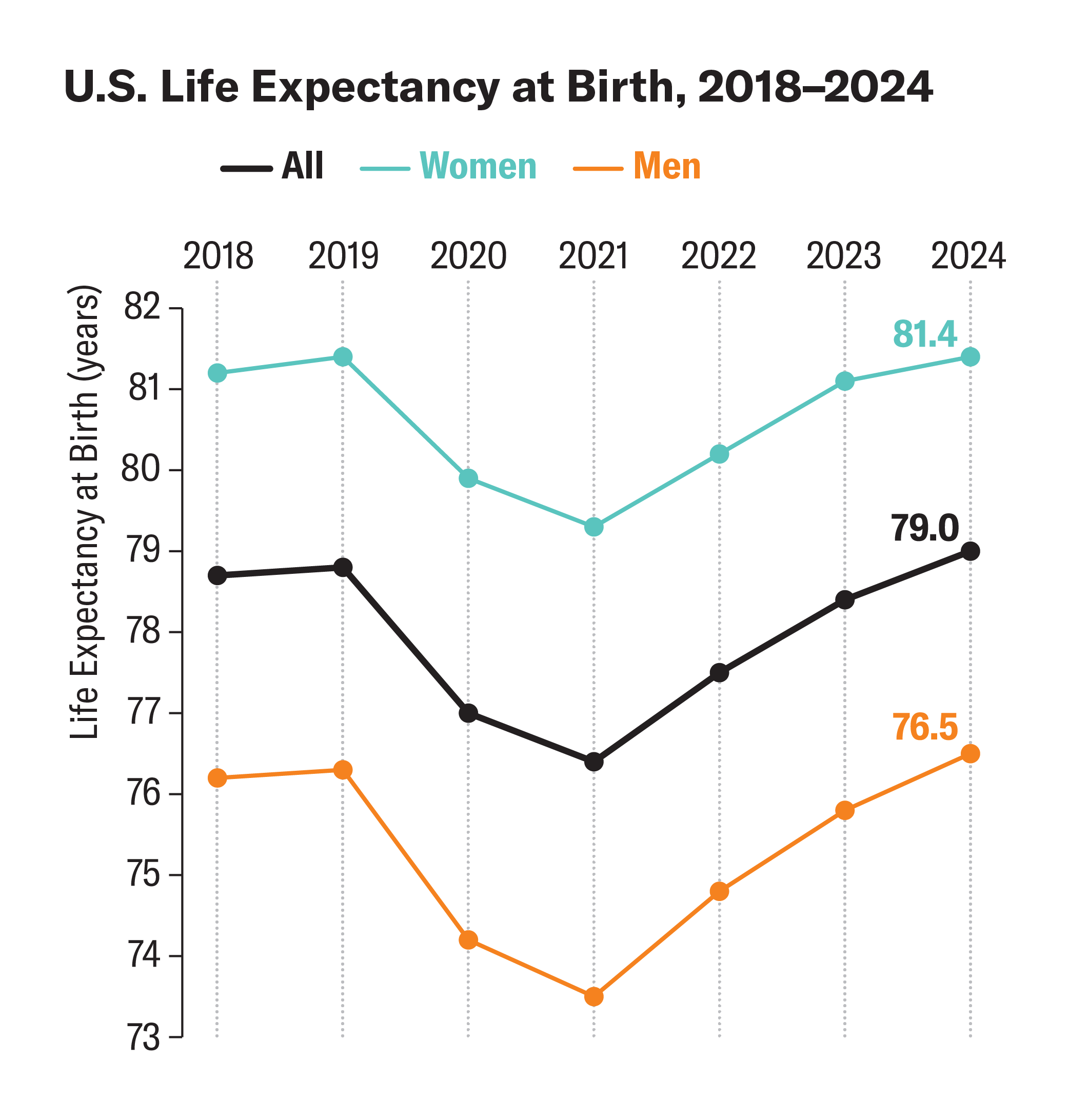
| | Amanda Montañez; Source: Centers for Disease Control and Prevention (data) | | Life expectancy in the U.S. rose by more than a half-year from 2023 to 2024, with the average American now predicted to live to age 79, according to new data released by the National Center for Health Statistics. In most developed countries, life expectancy in 2024 was in the low to mid-80s, according to the United Nations, reports Scientific American's Jeanna Bryner. U.S. life expectancy nevertheless remains "shockingly low," says demographer Philip Cohen at the University of Maryland, College Park.
Why this matters: As the graphic above illustrates, U.S. life expectancy appears to have recovered from the height of the COVID pandemic. And it is now higher than it was in any prior year going back to 1900. However U.S. infant mortality showed no change in 2024. And more people in the U.S. are losing health care coverage and basic public health receives less support these days, Cohen says.
What the experts say: "There are still critical problems in the U.S. public health profile. It should not be big news when the life expectancy rises, which happens every year in every other developed country," says Cohen.
| | Psychiatry's reference book on mental health and brain-related conditions, called the Diagnostic and Statistical Manual of Mental Disorders (DSM), is set to undergo a massive overhaul, reports Scientific American's Allison Parshall. One major element would involve creating more objective measures of disease—"biomarkers" that may indicate specific mental illnesses, the American Psychiatric Association (APA) announced. The revisions are aimed, in part, at making the dictionary of disorders more scientifically sound.
Why this matters: The proposed changes would allow practitioners to make more nuanced diagnoses, including ones with varying levels of specificity. The focus on biomarkers is controversial. For nearly all mental illnesses, reliable biological signatures do not exist. But researchers aim to design the manual to incorporate newly identified biomarkers if they become available.
What the experts say: "We have to do [the revision] right, so it might take a little bit of a time, but we'll try and do it as fast as possible because the field is ready for it," said APA psychiatrist Nitin Gogtay at a recent press conference about the changes.
| | | | |