Giant stars lit up the primitive cosmos ͏ ͏ ͏ ͏ ͏ ͏ ͏ ͏ ͏ ͏ ͏ ͏ ͏ ͏ ͏ ͏ ͏ ͏ ͏ ͏ ͏ ͏ ͏ ͏ ͏ ͏ ͏ ͏ ͏ ͏ ͏ ͏ ͏ ͏ ͏ ͏ ͏ ͏ ͏ ͏ ͏ ͏ ͏ ͏ ͏ ͏ ͏ ͏ ͏ ͏ ͏ ͏ ͏ ͏ ͏ ͏ ͏ ͏ ͏ ͏ ͏ ͏ ͏ ͏ ͏ ͏ ͏ ͏ ͏ ͏ ͏ ͏ ͏ ͏ ͏ ͏ ͏ ͏ ͏ ͏ ͏ ͏ ͏ ͏ ͏ ͏ ͏ ͏ ͏ ͏ ͏ ͏ ͏ ͏ ͏ ͏ ͏ ͏ ͏ ͏ ͏ ͏ ͏ ͏ ͏ ͏ ͏ ͏ ͏ ͏ ͏ ͏ ͏ ͏ ͏ ͏ ͏ ͏ ͏ ͏ ͏ ͏ ͏ ͏ ͏ ͏ ͏ ͏ ͏ ͏ ͏ ͏ ͏ ͏ ͏ ͏ ͏ ͏ ͏ ͏ ͏ ͏ ͏ ͏ ͏ ͏ ͏ ͏ ͏ ͏
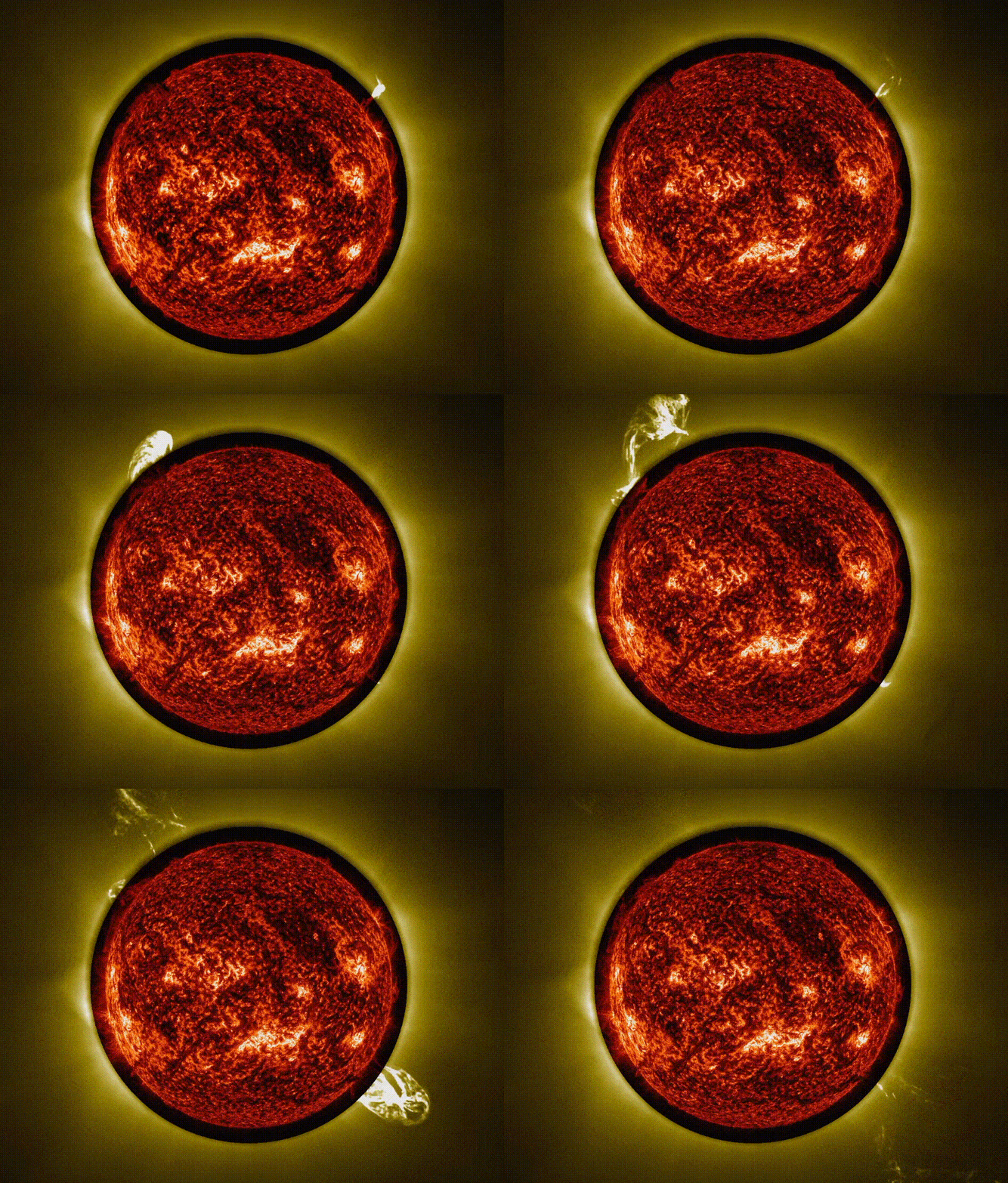
January 21, 2026—With the help of new telescopes and gravitational lensing, astronomers hope to see the oldest stars in the universe. Plus, deer may make forests glow, and scientists discover the oldest cave art. —Andrea Gawrylewski, Chief Newsletter Editor | | ESA/Proba-3/ASPIICS, NASA/SDO/AIA (CC BY-SA 3.0 IGO) | | - Would a brain in a vat—disconnected from any body—be capable of consciousness? Neuroscientists and philosophers have debated this thought experiment for decades as they have tried to understand how the organ generates awareness. What do you think? Can a brain be conscious without external input from the rest of the body or senses? What would that consciousness be like? Scroll down the article to the tan box and click "Join the Discussion" to add your perspective.
| | The first stars that formed in the earliest years of our universe are called Population III stars. The primal universe was a simpler place: Pop III stars would have been composed of hydrogen, helium and tiny traces of light elements such as lithium because those were the only elements that existed then. Astronomers believe these stars grew quickly into giants, and died quickly, leaving black holes as the monuments to their brief lives. Telescopes have spotted mega black holes from this time period, and they guess that such million-solar-mass objects formed as smaller black holes from Pop III stars merged under heavy gravity. But to confirm this idea, scientists want to get a first look at the oldest stars.
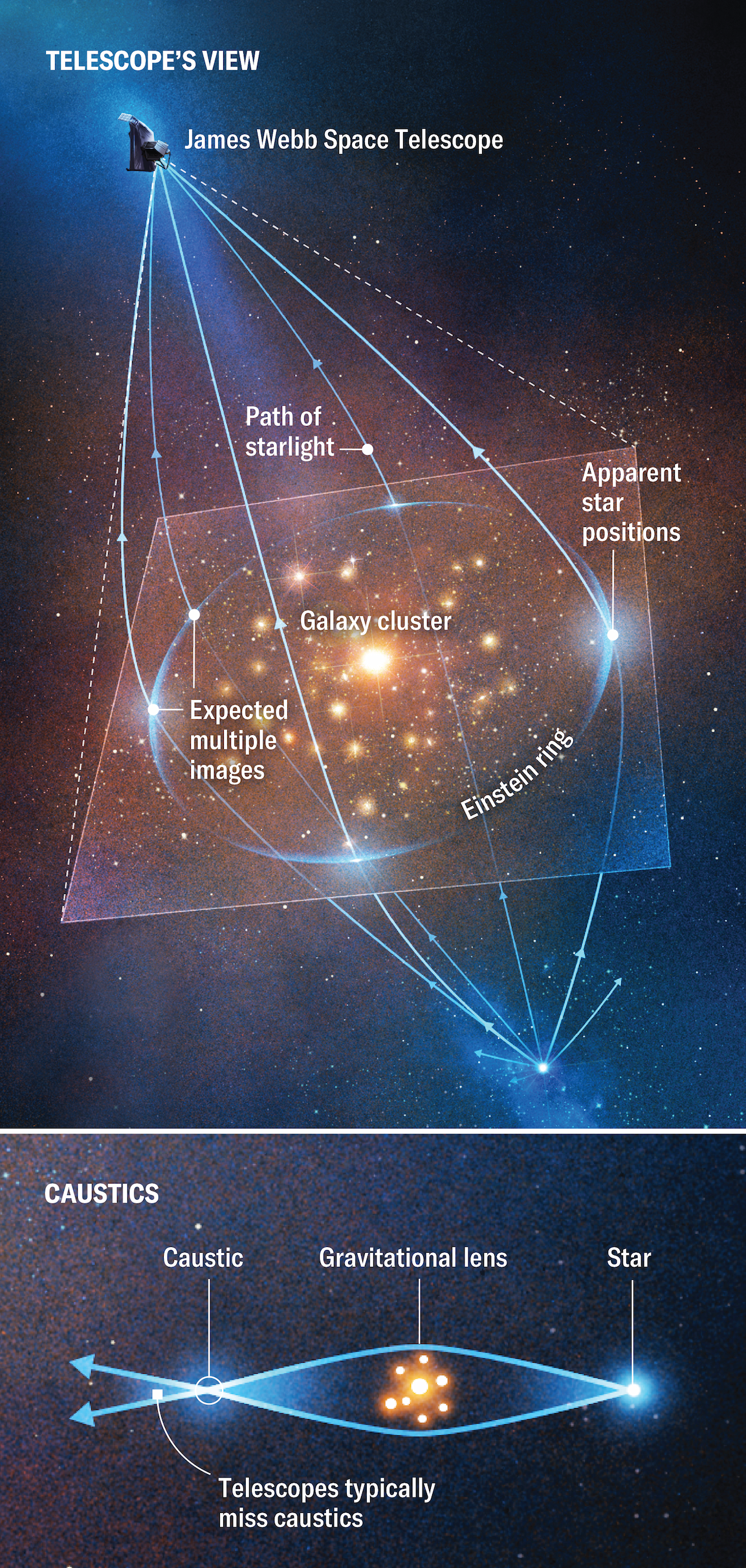
How to find old stars: Thanks to the James Webb Space Telescope and a phenomenon called gravitational lensing, researchers might soon get a glimpse of the first stars or detect their final explosions. We might even see the shining gas around their skeletal black holes, which would appear to us as a small quasar.
How it works: The density and curvature of a telescope's lens bends light traveling through it. This can be paired with naturally occurring gravitational lensing, where the gravity of dense regions of space curves the light from more distant objects in lens-like fashion. Light from behind the center of the gravitational lens will appear as a circle called an Einstein ring. Light might also travel along multiple distorted paths this way, producing copies of the background object.
| | Gravitational lenses magnify only a small portion of the space behind them, just as microscopes do. And the magnification provided by the gravitational lens is not uniform: most of the area behind the galaxy cluster is magnified by factors of less than 10, but in some very small regions, termed caustics, the effect can be very strong, with magnification factors of up to around 10,000. When JWST points at one of them, it acts like a telescope 100 times larger than it is, offering the opportunity to take a very high-resolution peek at the distant universe. | | NASA, ESA, CSA, STScI, Jose Diego (IFCA), Jordan D'Silva (UWA), Anton Koekemoer (STScI), Jake Summers (ASU), Rogier Windhorst (ASU), Haojing Yan (University of Missouri); Image Processing: Joseph DePasquale (STScI) | | An early star named Mothra (circled) appears in an ancient galaxy that existed three billion years after the big bang. The light from the galaxy and its stars has been warped and magnified by the mass of the closer galaxy cluster MACS0416, as seen in this image made with combined data from the Hubble and James Webb Space Telescopes. | | | | |
- An interactive map showing how much U.S. science funding has been cut under the Trump Administration. | Nature
- The future of college in the age of AI. | Intelligencer
- More and more terms for never-before-described emotions are appearing online. | MIT Technology Review
| | Because they were the first stars in the universe and therefore very old, Population III stars are called dinosaurs by astronomers. These cosmic relics were born into our universe during its earliest days—called the young universe. In astronomy, origins live in the past: to search for the universe's beginnings is to look backward in time, from a fleeting present that only we, on this small planet, are able to experience. | | In this moment and all those to come, thank you for being a part of our community of science lovers. Send any thoughts or feedback to: newsletters@sciam.com. Until tomorrow. —Andrea Gawrylewski, Chief Newsletter Editor | | | | |
Subscribe to this and all of our newsletters here. | | | | |