Even small things like a coffee cup have a gravitational pull. ͏ ͏ ͏ ͏ ͏ ͏ ͏ ͏ ͏ ͏ ͏ ͏ ͏ ͏ ͏ ͏ ͏ ͏ ͏ ͏ ͏ ͏ ͏ ͏ ͏ ͏ ͏ ͏ ͏ ͏ ͏ ͏ ͏ ͏ ͏ ͏ ͏ ͏ ͏ ͏ ͏ ͏ ͏ ͏ ͏ ͏ ͏ ͏ ͏ ͏ ͏ ͏ ͏ ͏ ͏ ͏ ͏ ͏ ͏ ͏ ͏ ͏ ͏ ͏ ͏ ͏ ͏ ͏ ͏ ͏ ͏ ͏ ͏ ͏ ͏ ͏ ͏ ͏ ͏ ͏ ͏ ͏ ͏ ͏ ͏ ͏ ͏ ͏ ͏ ͏ ͏ ͏ ͏ ͏ ͏ ͏ ͏ ͏ ͏ ͏ ͏ ͏ ͏ ͏ ͏ ͏ ͏ ͏ ͏ ͏ ͏ ͏ ͏ ͏ ͏ ͏ ͏ ͏ ͏ ͏ ͏ ͏ ͏ ͏ ͏ ͏ ͏ ͏ ͏ ͏ ͏ ͏ ͏ ͏ ͏ ͏ ͏ ͏ ͏ ͏ ͏ ͏ ͏ ͏ ͏ ͏ ͏ ͏ ͏ ͏
April 27, 2026—Today, Emma Gometz reports on a new measurement of the gravitational pull of all things. Plus, an earthquake false alarm in the Azores and electric air taxis take one step closer to reality. Welcome to a new week!
—Andrea Gawrylewski
Chief Newsletter Editor
|
|
Vertical Aerospace’s VX4 electric aircraft flies during a piloted transition test flight on April 14, 2026. Vertical Aerospace
|
|
- An electric air taxi just passed a crucial test, but certification, infrastructure and demand will decide how soon the craft will carry passengers. | 6 min read
- On Friday, President Trump fired all 22 members of the advisory board that oversees the U.S. National Science Foundation, a leading funder of basic science. | 4 min read
- A growing body of research suggests that GLP-1 drugs do more than control appetite and blood sugar—they might also fight inflammation. | 5 min read
- Around the world, more than two-thirds of the public believe at least one false or unproven health claim about about vaccines, raw milk, and more, a new survey finds. | 4 min read
- Nacre is a lustrous substance mollusks use to line their shells. It has an internal nanoscale architecture that is becoming prized by materials scientists. | 5 min read
- Preeclampsia is a life-threatening and common condition in pregnancy with no real treatment other than immediate delivery. A new study suggests that filtering the blood of a particular protein could help. | 3 min read
- Comet 3I/ATLAS sped through our solar system last summer. New measurements of its molecular makeup show an excess of heavy water molecules that is dramatically different from the composition of anything known to have ever formed around our sun. | 4 min read
|
|
If you throw a baseball up into the sky, it will return to Earth at an acceleration of 9.80665 m/s2. That’s Earth’s gravitational force, also known as “little g.” But every object in the universe, not just huge planets, exerts some gravitational force on everything else—how much is determined by the gravitational constant, or “big G.” The problem is big G is so small that it’s notoriously difficult to directly measure and previous attempts to measure it have shown there’s still a relatively large degree of uncertainty. Earlier this month, Stephan Schlamminger, a physicist at the National Institute of Standards and Technology, completed a 10-year quest to measure G once more.
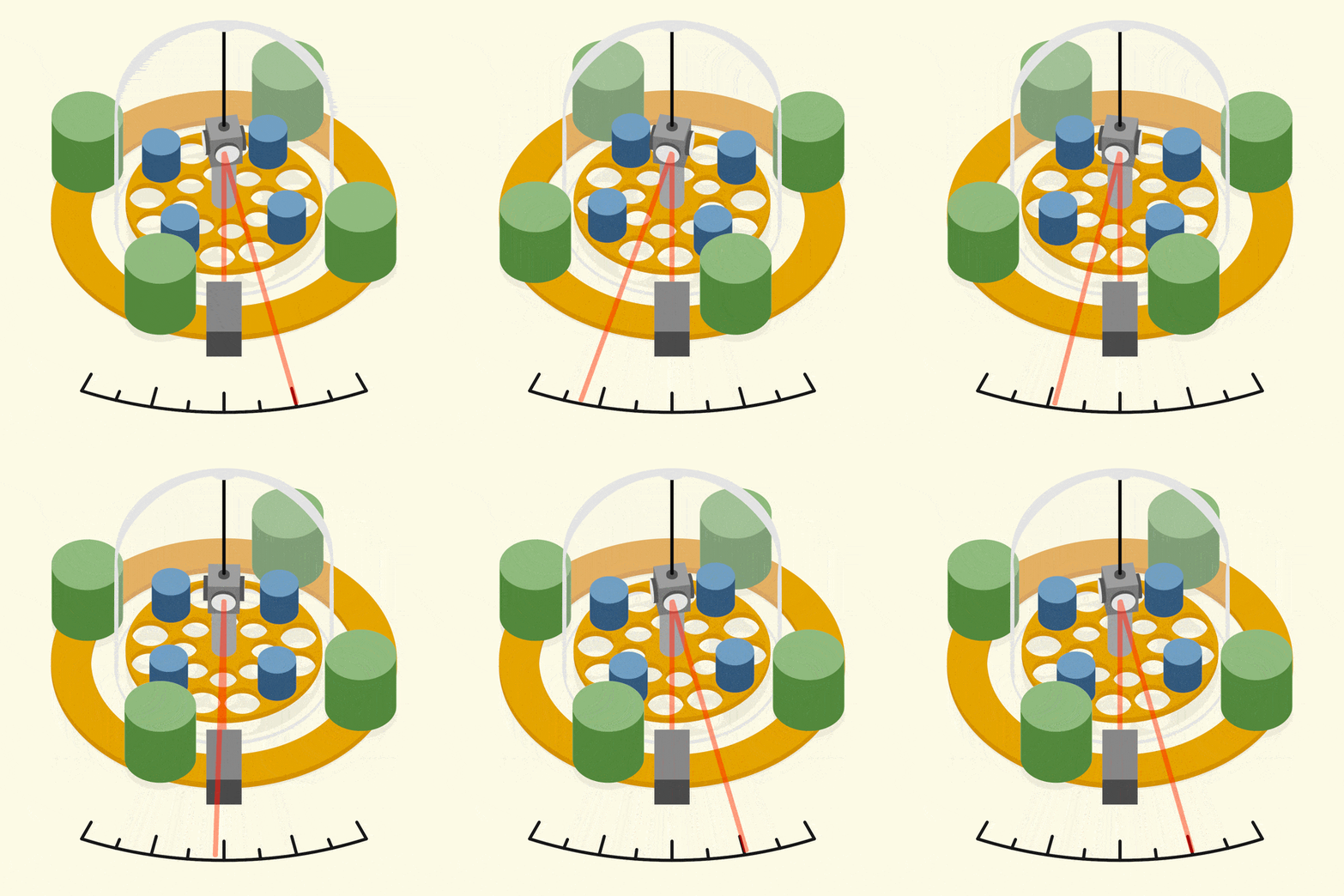
How he did it: The experiment used torsion disks: two large weights balanced on an outer disk and two smaller weights on an inner disk. The small weights are gravitationally attracted to the large weights, and the angle of how far the disk with the small weights turns toward the large weights is used to calculate the value of big G. Schlamminger’s team used both copper and sapphire weights, to avoid any error that might have resulted from the material itself, like magnetic interactions. The final number they calculated for big G was 6.67387 × 10⁻¹¹m3kg-1s-2.
|
|
|
|
|
Setup at NIST for measuring the strength of gravity.S. Kelley/NIST
|
|
What the experts say: Schlamminger completed his measurement without actually knowing the final value to avoid bias. He was so nervous before revealing the true measurement at a conference in Colorado that he spent the morning away from his thoughts at his hotel’s water park. Although the result did not match previous measurements of big G, the exercise is a useful way to test the precision of measurement tools. “I think it’s always worth having one more measurement,” says Terry Quinn, former director of the International Bureau of Weights and Measures and author of a previous study that measured big G. The mystery continues! —Emma Gometz, newsletter editor
|
|
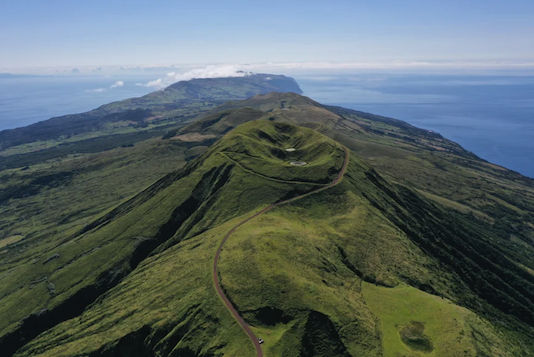
The valleys scoring through São Jorge Island's central spine are surface expressions of the fault the magma was sneaking up through. Ricardo Ramalho
|
|
On March 19, 2022, São Jorge Island—a volcanic isle in Portugal’s Azores archipelago—experienced thousands of tremors suggesting an earthquake was imminent. But none ever occurred. In the days and months after the tremor swarm began, scientists placed dozens of extra seismic sensors on the island, on the surrounding seafloor and on several nearby islands. By detecting more than 18,000 additional quakes, scientists were able to better understand what had occurred, and where, beneath São Jorge.
What happened: Scientists examined the seismic data as well as GPS data and satellite images. Just prior to the explosion of seismic activity, a sheet of magma that could fill about 32,000 Olympic-size swimming pools had rocketed up from a depth of at least 12 miles to just a mile below São Jorge’s surface in less than a day’s time. The magma hit a rigid geologic barrier at the base of São Jorge and its fluids and gases leaked out into the Pico do Carvão fault system, a preexisting labyrinth of channels (you can see evidence of this in a visible trench on the island’s surface). This reduced the magma’s buoyancy and triggered thousands of modest quakes.
What the experts say: “This is a bit of a wake-up call that these things could happen really quickly, and perhaps more quietly, than we anticipated,” says Rebecca Williams, a volcanologist at the University of Hull in England. If an eruption had taken place, many people would have been in harm’s way.
|
|
-
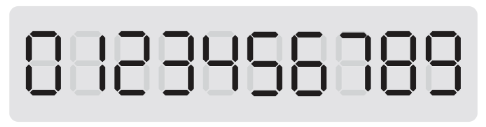
I own a digital 24-hour clock (i.e., a military time clock) that displays in HH:MM format. Each digit uses the standard seven-segment display in which seven lights toggle on or off to form numbers, as shown below. This involves 28 total light segments: four digits on the display times seven segments per digit. On my clock, some of these light segments are broken and never turn on. Despite this, with some practice, I can always tell what time it is—the displayed pattern of lights is never ambiguous. What is the maximum number of segments that can be broken?
Click here for the solution.
|
|
- How much of a threat is COVID still? | STAT
- A researcher found the elusive sack-bearer moth in Florida. The creature was previously thought to be extinct. | Colorado Arts and Sciences Magazine
- A wonderful interactive set of graphics shows how people search for and identify birds. | Searching for Birds
|
|
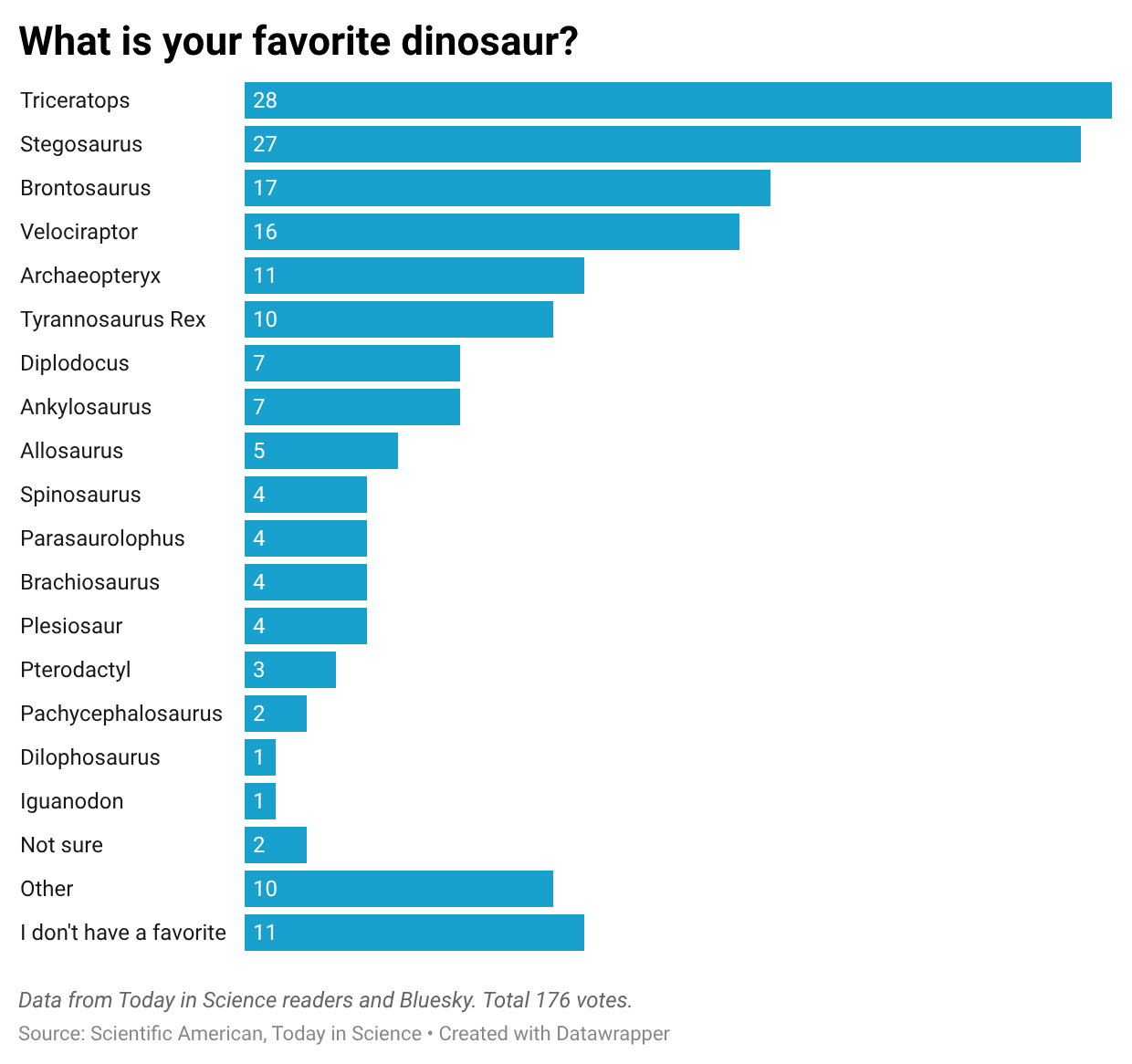
The results are in from our Favorite Dinosaur poll last week. Check them out below! Looking at the responses, the prompt should really have been "What is your favorite prehistoric creature?" as at least one of the below species is not technically a dinosaur. I'm still pretty pleased with the top choices.
|
|
The real fun began when we dug through the "other" entries of dino species that people loved. Again, some of these aren't technically dinosaurs, but all are extremely cool to look at (you can imagine the rabbit hole I went down googling each of these names):
Albertosaurus
Deinonychus
Patagotitan
Bicharracosaurus
Ichthyosaur (technically a marine reptile)
Dimorphodon (a winged Pterosaur)
Thesaurus (people, you make me laugh)
Doyouthinquisawrus Rex (from a Jurassic Park fan)
Troodon (a controversial species that has been reclassified into a new genus)
I knew I could depend on our readers to give fun, informed and unique responses. Thank you for voting!
|
|
You can send questions, comments, or feedback on this newsletter to me directly: newsletters@sciam.com or take our survey below at any time. See you tomorrow!
—Andrea Gawrylewski, Chief Newsletter Editor
|
|
|
|
|
Subscribe to this and all of our newsletters here.
|
|
|
|
|