The Orion capsule is configuring for reentry and scheduled to splashdown in the Pacific Ocean ͏ ͏ ͏ ͏ ͏ ͏ ͏ ͏ ͏ ͏ ͏ ͏ ͏ ͏ ͏ ͏ ͏ ͏ ͏ ͏ ͏ ͏ ͏ ͏ ͏ ͏ ͏ ͏ ͏ ͏ ͏ ͏ ͏ ͏ ͏ ͏ ͏ ͏ ͏ ͏ ͏ ͏ ͏ ͏ ͏ ͏ ͏ ͏ ͏ ͏ ͏ ͏ ͏ ͏ ͏ ͏ ͏ ͏ ͏ ͏ ͏ ͏ ͏ ͏ ͏ ͏ ͏ ͏ ͏ ͏ ͏ ͏ ͏ ͏ ͏ ͏ ͏ ͏ ͏ ͏ ͏ ͏ ͏ ͏ ͏ ͏ ͏ ͏ ͏ ͏ ͏ ͏ ͏ ͏ ͏ ͏ ͏ ͏ ͏ ͏ ͏ ͏ ͏ ͏ ͏ ͏ ͏ ͏ ͏ ͏ ͏ ͏ ͏ ͏ ͏ ͏ ͏ ͏ ͏ ͏ ͏ ͏ ͏ ͏ ͏ ͏ ͏ ͏ ͏ ͏ ͏ ͏ ͏ ͏ ͏ ͏ ͏ ͏ ͏ ͏ ͏ ͏ ͏ ͏ ͏ ͏ ͏ ͏ ͏ ͏
April 10, 2026—Artemis II returns to Earth, human minds frequently misjudge risk, and what would happen if the U.S. bombed Iran's nuclear plant. Here we go.
—Andrea Gawrylewski
Chief Newsletter Editor
|
|
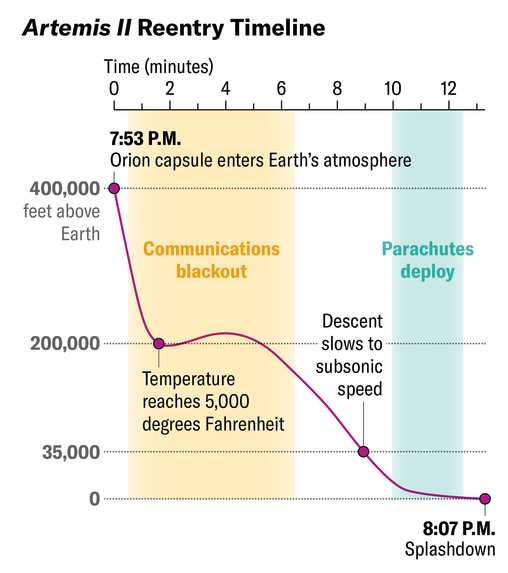
Well, folks, mission end is finally upon us. After 10 remarkable days breaking records, capturing unprecedented imagery and reflecting on the wonders of space travel, the Artemis II mission to the moon is scheduled to return home tonight. If all goes well, the Orion capsule carrying four astronauts—Reid Wiseman, Victor Glover, Christina Koch and Jeremy Hansen—is scheduled to splash down in the Pacific Ocean off the coast of San Diego, Calif., at 8:07 P.M. EDT. Here's a timeline of reentry (all times in EDT and all subject to change):
This afternoon: The crew configured the capsule for reentry—stowing away baggage and gear—and initiated a final trajectory-course-correction burn to get them on the proper track for Earth. They are reviewing their reentry checklist and making sure they’re each properly in their spacesuits, which will help protect them on what could be a bumpy ride down.6:30 P.M.: NASA will begin its livestream of reentry.7:25 P.M.: The Orion capsule will ditch its bulky service module.7:37 P.M.: The Orion capsule will perform a quick burn to maneuver into the right position and attitude for reentry and splashdown.7:53 P.M.: Orion will reenter Earth’s upper atmosphere some 400,000 feet above the surface, kicking off a 13-minute descent. At this time, the capsule will be traveling at about 24,000 miles an hour. A six-minute communications blackout will begin. 8:02 P.M.: The capsule will be traveling just under the speed of sound at around 35,000 feet above Earth’s surface; it will begin deploying its four sets of parachutes.8:07 P.M.: Splashdown.
Within two hours of the astronauts’ splashdown, divers will help extract them from the capsule (the extraction order will be: Koch, Glover, Hansen, Wiseman) and get them into helicopters that will carry them to the awaiting USS John P. Murtha, where they’ll undergo preliminary medical exams before being taken to solid ground.
|
|
Amanda Montañez; Source: NASA (reference)
|
|
- NASA plans to launch a wildly ambitious nuclear-powered octocopter called Dragonfly to explore Saturn’s largest moon, Titan, in 2028. | 5 min read
- An analysis by a nonprofit science advocacy group identified 54 NASA missions that may be endangered by the White House’s budget proposal for the coming fiscal year. | 3 min read
|
|
-
Why can’t humans regenerate limbs? Oxygen and hyaluronic acid may play a role in tissue recovery and regeneration, two new studies suggest . | 3 min read
- A conversation with author Alexis Hall about her latest book Hell's Heart, which reimagines Herman Melville’s classic Moby Dick as a sci-fi adventure with space whales. | 21 min podcast
- Decades of data show that mammal species in the wildlife trade—from pet sales to meat markets to illegal poaching—are much more likely to share at least one transmissible pathogen with humans. | 2 min read
- Bombing Iran’s Bushehr nuclear power plant could release long-lasting radioactive cesium 137 into the Persian Gulf, causing environmental calamity and threatening drinking-water supplies for millions. | 3 min read
|
|
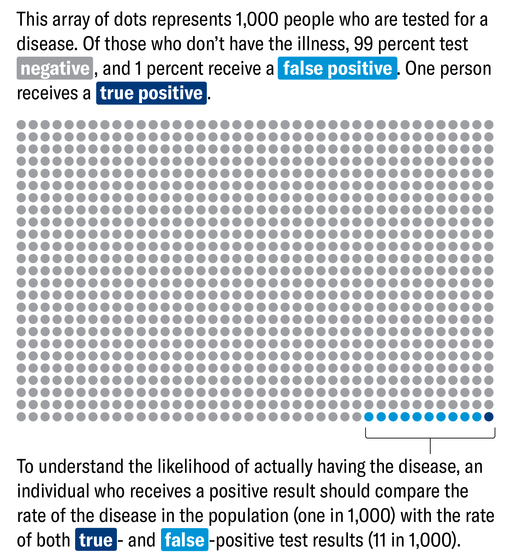
If we have good tests for rare diseases, why not test everyone for them all the time? This question is at the center of the false positive paradox, which shows how our minds don’t always assess risk in a statistically accurate way. When testing for rare outcomes in an indiscriminate pool of people, a false positive will usually be more likely than a true positive.
A hypothetical example: Let’s say a doctor randomly decides to administer a blood test on you to scan for a certain disease that affects one in 1,000 people. The test is remarkably effective: it never gives a false negative. False positives are rare: 1 percent of people receive a false positive. Only one person out of 1,000 receives a true positive. So what are your chances of actually having the disease if you get a positive result? With the given parameters, the chance is only about 9 percent. You likely instinctively guessed a much higher probability. This is an example of the false positive paradox: when people judge the likelihood of a scenario, they tend to overweight the specific details in front of them and underweight the general prevalence of that scenario.
Real-life scenarios: This statistical paradox can extend far beyond the medical world. In 2017, the Welsh police used automated facial recognition software on footage of about 170,000 soccer fans attending a championship final to try and find persons of interest. The system flagged 2,470 potential criminals, but 2,297 were false positives. The software worked as intended—this is what happens when a small chance of error is applied to a huge pool of people. —Emma Gometz, newsletter editor
|
|
|
|
|
|
A SPECIAL SCIENTIFIC AMERICAN EVENT
|
|
A new theory of heart disease
|
|
Chronic inflammation may be the hidden force driving cardiovascular disease, according to new research. Once met with skepticism, this idea is now gaining acceptance and is fueling debate around recent FDA‑approval of an inexpensive drug, colchicine, to treat heart disease. Join our health editors Tanya Lewis and Josh Fischman for an engaging conversation on the new theories around heart disease. Moderated by Seth Fletcher, our editorial director.
|
|
|
|
|
|
MOST POPULAR STORIES OF THE WEEK
|
|
- How Artemis II is beaming back stunning video from the moon | 5 min read
- Is the ‘Ghost Murmur’ quantum device possible? Scientists are skeptical | 3 min read
- NASA’s Artemis II astronauts are officially farther from Earth than any human has gone before | 2 min read
|
|
I'd be lying if I said I wasn't a bit nervous for reentry tonight. So far, this mission has gone better than even NASA could have imagined. Perhaps more importantly, I've really enjoyed the camaraderie (among colleagues, readers, and people around the world) that has built up while watching this voyage. I know I'm not alone in wishing that the positive feelings on Earth and the remarkable engineering feats of scientists past and present can combine to bring this mission to a happy conclusion.
|
|
Thank you for sharing your thoughts and questions about the Artemis II mission with us here at Scientific American for the last 10 days. Your curiosity fuels everything we do! Follow along with our coverage of reentry here, and keep sending me your thoughts and questions: newsletters@sciam.com.
—Andrea Gawrylewski
Chief Newsletter Editor
|
|
|
|
|
Subscribe to this and all of our newsletters here.
|
|
|
|
|