Plus, SpaceX’s orbital AI plan could choke Earth in pollution ͏ ͏ ͏ ͏ ͏ ͏ ͏ ͏ ͏ ͏ ͏ ͏ ͏ ͏ ͏ ͏ ͏ ͏ ͏ ͏ ͏ ͏ ͏ ͏ ͏ ͏ ͏ ͏ ͏ ͏ ͏ ͏ ͏ ͏ ͏ ͏ ͏ ͏ ͏ ͏ ͏ ͏ ͏ ͏ ͏ ͏ ͏ ͏ ͏ ͏ ͏ ͏ ͏ ͏ ͏ ͏ ͏ ͏ ͏ ͏ ͏ ͏ ͏ ͏ ͏ ͏ ͏ ͏ ͏ ͏ ͏ ͏ ͏ ͏ ͏ ͏ ͏ ͏ ͏ ͏ ͏ ͏ ͏ ͏ ͏ ͏ ͏ ͏ ͏ ͏ ͏ ͏ ͏ ͏ ͏ ͏ ͏ ͏ ͏ ͏ ͏ ͏ ͏ ͏ ͏ ͏ ͏ ͏ ͏ ͏ ͏ ͏ ͏ ͏ ͏ ͏ ͏ ͏ ͏ ͏ ͏ ͏ ͏ ͏ ͏ ͏ ͏ ͏ ͏ ͏ ͏ ͏ ͏ ͏ ͏ ͏ ͏ ͏ ͏ ͏ ͏ ͏ ͏ ͏ ͏ ͏ ͏ ͏ ͏ ͏
November 18, 2026—What’s behind the string of critical tech outages, the mystery of the Grand Canyon’s formation and Voyager 1’s “light-day” milestone.
—Robin Lloyd, Contributing Editor
|
|
The Canyon’s Secrets
The formation of the Grand Canyon has puzzled geologists ever since John Wesley Powell made his 1869 Colorado River expedition through the canyon. One mystery concerns the path of the Colorado River through the eastern part of the canyon, especially where its southward flow takes a sudden hard right to the west and across an uplift. Two theories based on radioisotope decay evidence have emerged to explain the crazy course of the river through the 9,200-foot Kaibab Plateau, reports freelance science journalist Stephanie Pappas.
|
|
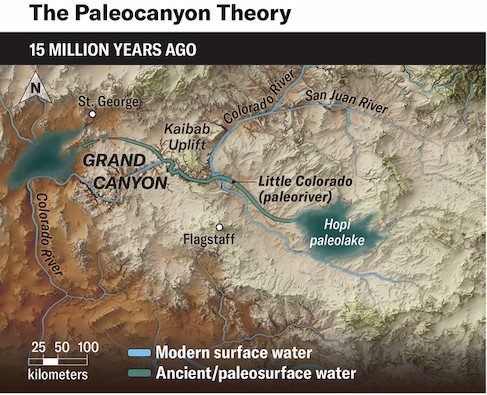
The Paleocanyon Theory: Between 25 million and 15 million years ago, when the surface elevation of the Kaibab Plateau was different than it is today, an ancient river ran from east to west through the plateau and cut a shallow canyon. Much about this and other ancient waterways is uncertain. But six million to seven million years ago, when the Colorado River arrived, it would have flowed through the low spots in the ancient landscape, including the existing paleocanyon through the Kaibab. This started the process of carving the Grand Canyon, which continues today.
|
|
Jo Hannah Asetre; Source: “Formation of the Grand Canyon 5 to 6 Million Years ago through Integration of Older Paleocanyons,” by Karl E. Karlstrom et al., in Nature Geoscience. Published online January 26, 2014 (reference)
|
|
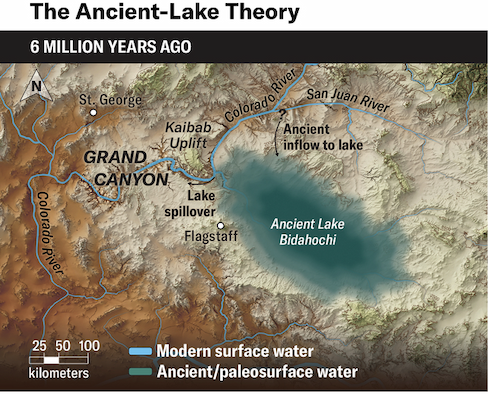
The Ancient-Lake Theory: Six million years ago the Colorado River filled the Bidahochi basin east of today’s Grand Canyon and turned it into a giant lake perhaps as long as the modern Great Salt Lake, though researchers don’t agree on its size. As the Colorado River continued to flow into this basin, the lake’s surface would have reached the top of the Kaibab. Eventually the water would have spilled over the plateau, giving the river passage. The Colorado then began the steady carving of the Grand Canyon.
|
|
Jo Hannah Asetre; Source: U.S. Geological Survey (reference).
|
|
What the experts say: Ryan Crow, a geologist with the team behind the ancient lake theory, thinks a debate isn't necessary; perhaps both the lake and paleocanyon existed, and the paleocanyon provided the path for lake spillover. “I think we agree that multiple processes could have been involved,” Crow says of the two camps.
|
|
Join the discussion: Have you been lucky enough to visit the Grand Canyon or venture below its rim? What was your impression and how did it affect you? Share your experience with our community here.
|
|
Tao on Math and AI
We spoke to Scientific American senior reporter Joe Howlett yesterday about his December cover story on the current crisis in mathematics. This week, Joe attended a Q&A event featuring mathematician Terence Tao, one of the most influential in the field. Here’s Joe:
When I heard Tao was participating in a Q&A at Brooklyn’s Pioneer Works with cosmologist Janna Levin, I knew I had to be there. Levin repeatedly called it “the most important event we've ever hosted.” Tao was there to promote his popular math book, Six Math Essentials, which is not about AI. Levin called it “a very humble and warm and, dare I say, human book.”
The talk: Much of the conversation focused on this year’s headline-making battle for math’s soul. Tao has become the public’s primary communicator from the trenches. He’s also become something of an oracle for what might happen to professions that AI hasn’t yet blown up. As Levin put it, “Math is being used as a proof of concept—a demonstration—but we should understand that it's coming for all of us.”
The takeaways: Tao acknowledged that his views on AI have become far more critical this year. He started out thinking that AI agents would soon be helpful “co-pilots” for mathematicians. “The hope was that as long as the human mathematicians were in charge,” Tao said, “you could do all kinds of new things.” But as the year progressed, “these tools became strong enough to do things on their own.” AI companies largely stopped collaborating with mathematicians and started automating their work entirely, he said. The math community was blindsided and is still struggling with how to respond. “Broadly in society, we have to think, for everything that we do, is the outcome what we want, or is it the process?” he said. “People have all these goals, but sometimes the value in these goals comes from the way you achieve them.”
|
|
|
|
|
-
BREAKING: Everything. | 404 Media
-
What’s behind the string of tech outages disrupting business and travel. | The Wall Street Journal
-
Four ways the U.S. measles status could affect you. | The Washington Post
-
Are you a budding science sleuth? Take our plagiarism quiz to test your skills. | Nature
|
|
This newsletter is powered by caffeine, existential curiosity and subscribers to Scientific American. Join us: 90 days for just $1.
|
|
In all our work, Scientific American editors are on the look-out for any false promises in touted advances. This discerning perspective underlies MIT Technology Review's recent series, “Are we there yet? Six technologies that promised to change the world.” Check out their assessments of what’s holding back nuclear-powered spaceships, exercise in a pill and other potentially transformative goals. Each assessment ends with a progress score, from zero to ten.
|
|
—Robin Lloyd, Contributing Editor
|
|
|
|
|
Subscribe to this and all of our newsletters here.
|
|
Scientific American
1000 N West Street, Suite 1200
|
|
|
|
|