The FDA is reportedly considering broadening the types of drugs that can be sold without a prescription ͏ ͏ ͏ ͏ ͏ ͏ ͏ ͏ ͏ ͏ ͏ ͏ ͏ ͏ ͏ ͏ ͏ ͏ ͏ ͏ ͏ ͏ ͏ ͏ ͏ ͏ ͏ ͏ ͏ ͏ ͏ ͏ ͏ ͏ ͏ ͏ ͏ ͏ ͏ ͏ ͏ ͏ ͏ ͏ ͏ ͏ ͏ ͏ ͏ ͏ ͏ ͏ ͏ ͏ ͏ ͏ ͏ ͏ ͏ ͏ ͏ ͏ ͏ ͏ ͏ ͏ ͏ ͏ ͏ ͏ ͏ ͏ ͏ ͏ ͏ ͏ ͏ ͏ ͏ ͏ ͏ ͏ ͏ ͏ ͏ ͏ ͏ ͏ ͏ ͏ ͏ ͏ ͏ ͏ ͏ ͏ ͏ ͏ ͏ ͏ ͏ ͏ ͏ ͏ ͏ ͏ ͏ ͏ ͏ ͏ ͏ ͏ ͏ ͏ ͏ ͏ ͏ ͏ ͏ ͏ ͏ ͏ ͏ ͏ ͏ ͏ ͏ ͏ ͏ ͏ ͏ ͏ ͏ ͏ ͏ ͏ ͏ ͏ ͏ ͏ ͏ ͏ ͏ ͏ ͏ ͏ ͏ ͏ ͏ ͏
February 23, 2026—How to make more drugs available over-the-counter, the ways social media fuels polarization, and why many Olympic medals broke. —Andrea Gawrylewski, Chief Newsletter Editor | | For the Milan Cortina medals, instead of a traditional metal loop soldered to the outside, the ribbon feeds directly into an internal cavity hidden between the two halves of the medal. Mattia Ozbot/Getty Images | | Last week, FDA commissioner Martin Makary told CNBC that "everything should be over the counter" except drugs that are deemed unsafe or addictive or that require clinical monitoring. How would such a change work? Markary said the agency is following the "proper regulatory process," to identify which drugs might be affected, though he did not provide more detail. Some medicines could move to over-the-counter (OTC), but "everything" is certainly an overstatement, experts say.
How it would work: Some drugs that have made the switch from prescription to OTC have undergone rigorous scientific testing and evaluation so that the medicines can be taken without close oversight. The path to applying that to many more drugs would require similar evaluations. Major factors that need to be considered: - Some drugs have strict therapeutic windows in dosing before something becomes toxic (some drugs can become very toxic with only small increases in dose). Some medicines like those for the heart and pulmonary systems require monitoring and administration.
- Some medicines interact with other medications or certain foods and substances. For more drugs to go OTC they would require more detailed labels and things could get complicated quickly, experts say.
- The question of insurance. Most insurance plans don't cover over-the-counter drugs, so how coverage might shift if more medicines move away from prescriptions is an open question.
What the experts say: Moving many more medicines to OTC would shift a lot of medical responsibility onto the individual—potentially increasing the risk of safety issues or drug misuse, experts say. "There's no end to the nuances here that you're asking patients to be more aware of," from understanding how to take the drugs correctly to clarifying what drug-to-drug interactions may occur, says Paul Beninger, a retired professor of public health and community medicine at Tufts University.
| | Is social media causing political polarization? Social media companies are notoriously secretive about their algorithms, so scientists are limited in what they can investigate. In the first study of its kind, an experiment published in Science showed that the prominence of polarizing political content on X feeds affects users' views of people with the opposite political orientation.
How they did it: The researchers created a browser extension that used a large language model (LLM) to analyze social media post language for attitudes linked to polarization, like partisan animosity or support for undemocratic practices, in the feeds of 1,200 participants on X in the leadup to the 2024 election. Then, the researchers' LLM automatically pushed down the polarizing posts in some feeds and moved up the posts for others. Regardless of political orientation, those for whom polarizing posts were de-emphasized shared in a survey that they felt warmer toward the group that opposed their viewpoints than those with unaltered feeds. Those who got polarizing posts toward the top of their feeds felt comparatively coldest towards politically opposing groups.
What the experts say: Even though the findings are somewhat depressing, the fact that this research tool can tweak how users see polarizing content without platform approval is exciting. "Only the platforms have had the power to shape and understand these algorithms," says study co-author and University of Washington information scientist Martin Saveski. "This tool gives that power to independent researchers." —Emma Gometz, newsletter editor | | | | |
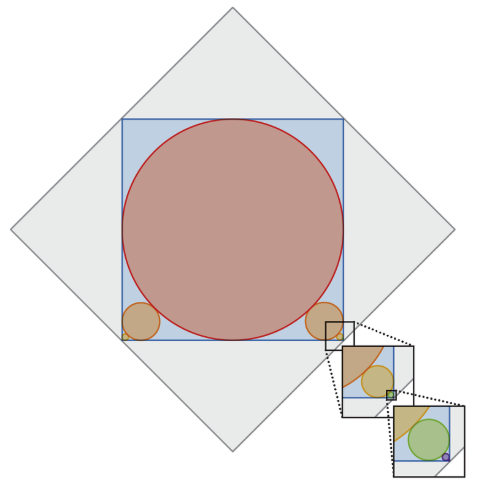
- A red circle is inscribed inside a blue square. The arrangement leaves gaps in the square's four corners, two of which are filled with smaller circles that just barely touch the big red circle and the two corner sides of the blue square. This, in turn, leaves two smaller gaps in the corners, which are filled with smaller circles, and so on, with ever smaller circles ad infinitum. The entire diagram is inscribed inside of a 1 × 1 gray square. What is the total circumference of all the circles? Find the solution here.
| | - The ripple effect of government cuts to science, which may cause irreparable damage. | The New York Times
- Why do humans have a prominent lower chin? Evolutionary biologists may know why. | New Scientist
- In China, startups are racing to move brain-computer interface devices from research to market. | TechCrunch
| | I'm writing to you today at the tail-end of a powerful blizzard that just dumped nearly 20 inches of snow on Central Park in New York City. I went out for a walk last night after the mayor declared a travel ban restricting all non-essential vehicles, e-bikes, scooters and mopeds from being on the road. Firstly, the trees looked magical coated in heavy snow. But what was most striking was how a roiling storm can still bring one of the busiest cities into quiet and stillness. | | Did you get snow? Let me know and send any other feedback or comments to: newsletters@sciam.com. See you tomorrow! —Andrea Gawrylewski, Chief Newsletter Editor
| | | | |
Subscribe to this and all of our newsletters here. | | | | |