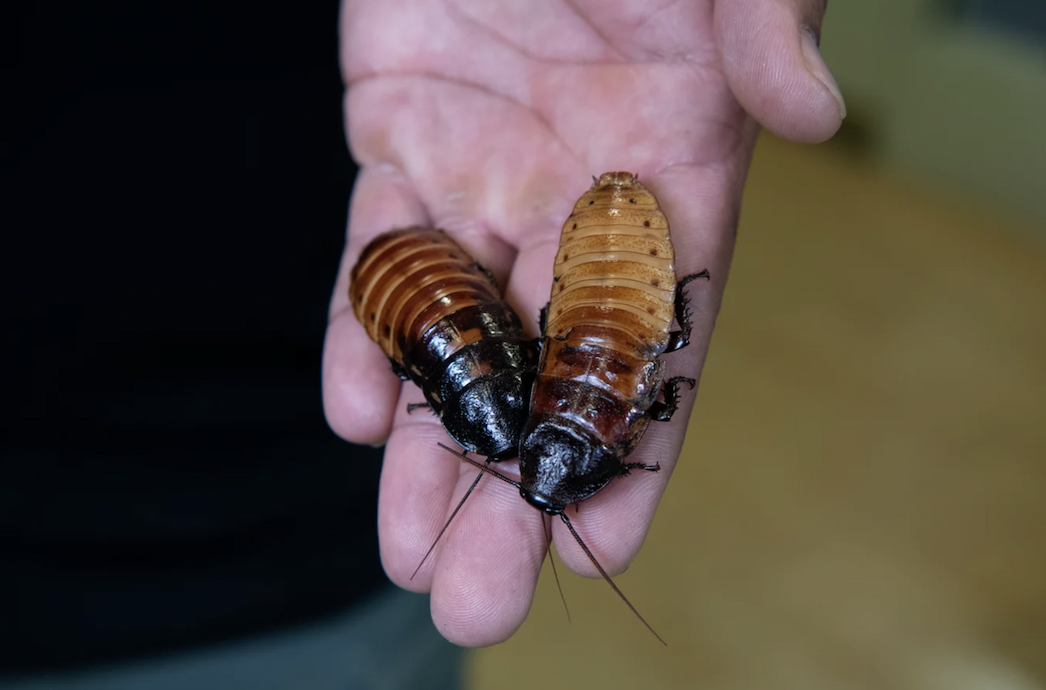
Plus, what's more romantic than a roach? ͏ ͏ ͏ ͏ ͏ ͏ ͏ ͏ ͏ ͏ ͏ ͏ ͏ ͏ ͏ ͏ ͏ ͏ ͏ ͏ ͏ ͏ ͏ ͏ ͏ ͏ ͏ ͏ ͏ ͏ ͏ ͏ ͏ ͏ ͏ ͏ ͏ ͏ ͏ ͏ ͏ ͏ ͏ ͏ ͏ ͏ ͏ ͏ ͏ ͏ ͏ ͏ ͏ ͏ ͏ ͏ ͏ ͏ ͏ ͏ ͏ ͏ ͏ ͏ ͏ ͏ ͏ ͏ ͏ ͏ ͏ ͏ ͏ ͏ ͏ ͏ ͏ ͏ ͏ ͏ ͏ ͏ ͏ ͏ ͏ ͏ ͏ ͏ ͏ ͏ ͏ ͏ ͏ ͏ ͏ ͏ ͏ ͏ ͏ ͏ ͏ ͏ ͏ ͏ ͏ ͏ ͏ ͏ ͏ ͏ ͏ ͏ ͏ ͏ ͏ ͏ ͏ ͏ ͏ ͏ ͏ ͏ ͏ ͏ ͏ ͏ ͏ ͏ ͏ ͏ ͏ ͏ ͏ ͏ ͏ ͏ ͏ ͏ ͏ ͏ ͏ ͏ ͏ ͏ ͏ ͏ ͏ ͏ ͏ ͏
February 13, 2026—Happy almost-Valentine's Day. This week, I went to the Bronx Zoo to write a story about their romantic fundraising program involving ... cockroaches! Plus, how algorithms create political polarization, The Great Backyard Bird Count, and more. —Emma Gometz, Newsletter Editor | | - Kissing is more than 20 million years old. But evolutionary biologists still don't know why the behavior originated. | 14 min listen
- A study shows how algorithms cause political polarization, and a way to mitigate it. | 2 min read
- What happens when two supermassive black holes collide? | 5 min read
- A team of scientists invented "smart underwear" to help them count how many times the average person farts per day. | 2 min read
- For discussion: The Great Backyard Bird Count, an annual citizen science project that helps researchers assess bird populations, kicks off today. Are you participating? Let us know what birds you spot! Share your thoughts by scrolling down to the tan box on this article and clicking "Join the Discussion."
| | Two of the Bronx Zoo's Madagascar hissing cockroaches. Wildlife Conservation Society (WCS) | | On Monday, I schlepped to the Bronx Zoo to visit a lesser-known exhibit: the Madagascar hissing cockroaches. This is the zoo's 15th year promoting its Valentine's Day "Name a Roach" program, where it allows participants to symbolically name a roach from the exhibit for their loved one. These roaches don't immediately signal "romance"—they're nocturnal, live in large colonies, and are about the size of the palm of your hand (cringeworthy to some). But when I saw them wriggling there in the dark exhibit, I fell in love and set out to find out about the origins of this unusual program. Why this exists: Name a Roach came about as the zoo was trying to fundraise at a notoriously slow time of year for attendance, back in 2011. Zoo officials were skeptical, but the program became soaringly popular—almost 6,000 people named a roach that first year, and 60,000 have named one since the program's inception. Why it works: The program seems to resonate precisely because it's unexpected. "It's very anti–traditional Valentine's Day," says Debbie Schneiderman who runs the Name a Roach program. "But I think what we found is that people are not traditional." For someone who has it all, maybe naming a roach could be the perfect way to say "I love you." (After all, I did!) | | Scientists have observed what looks like a star blinking out of the sky. A yellow supergiant star about a dozen times heavier than our sun was nestled in the Andromeda galaxy in 2014 when it brightened then faded away, vanishing entirely from view by 2022. One team of astronomers published a paper yesterday claiming the vanished star was a failed supernova—a star that dies and, instead of exploding first, becomes a black hole right away. Why this is interesting: Despite the ongoing renaissance of research about black holes, scientists still don't exactly know how they form. This disappearing star wouldn't be the first time astronomers glimpsed a black hole born without a supernova, but it would be the closest, best candidate ever seen. What the experts say: The possible failed supernova is cloaked in space dust, meaning some scientists aren't convinced that a black hole is actually behind it. "Everyone's excited to look for failed supernovae—me included," says Emma Beasor, an astrophysicist at Liverpool John Moores University in England, who wasn't involved in the study. "But ... before we confirm one, what I want to do is rule out every other possible scenario that could cause a star to 'disappear.'" | | | | |
SPONSORED CONTENT FROM SCIENTIFIC AMERICAN TRAVEL | | 2027 Solar Eclipse on the Nile Experience the 2027 total solar eclipse—more than six minutes of totality—from the deck of a luxury Nile River ship on this incredible 10-day journey led by Chief of Reporters Clara Moskowitz. | | | | |
- Do you know the answer to the first question of today's science quiz? Also, don't miss today's Spellements. This week, eagle-eyed users spotted adduct, uvea, caduate, and lysis, which were missing from last week's puzzle's solutions. If you spot any bonus science terms from today's Spellements, please email them to games@sciam.com and we'll share them next week!
| | MOST POPULAR STORIES OF THE WEEK | | - The quirky geology behind Olympic curling stones | 4 min read
- What came before the big bang? | 8 min read
- Mathematicians issue a major challenge to AI: Show us your work | 3 min read
| | I've never understood why people don't like Valentine's Day. I think if there's anyone in your life that you want to share a heartfelt message with, the holiday is a great excuse. And as we've seen via "Name a Roach," there are a lot of creative and ironic ways to do it. Take, for example, a Valentine's Day wastewater treatment plant tour. What are the quirky ways you celebrate Valentine's Day? | | Please send any other cool ideas, comments or feedback on this newsletter to: newsletters@sciam.com. See you on Tuesday after the holiday. —Emma Gometz, Newsletter Editor
| | | | |
Subscribe to this and all of our newsletters here. | | | | |