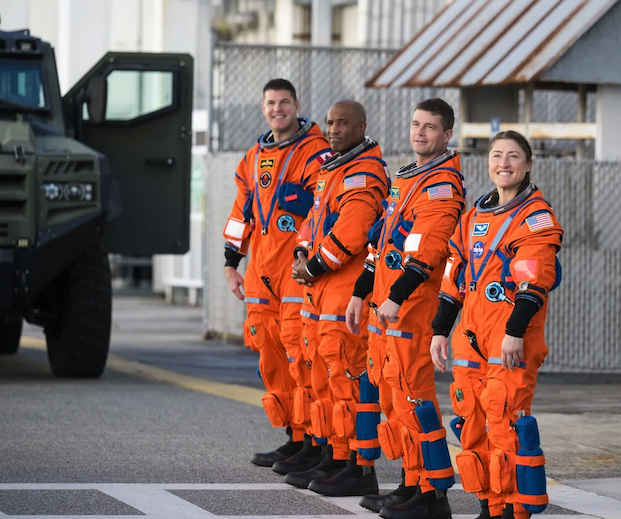
If all goes well, Artemis II astronauts will be the first humans to leave Earth orbit since 1972 ͏ ͏ ͏ ͏ ͏ ͏ ͏ ͏ ͏ ͏ ͏ ͏ ͏ ͏ ͏ ͏ ͏ ͏ ͏ ͏ ͏ ͏ ͏ ͏ ͏ ͏ ͏ ͏ ͏ ͏ ͏ ͏ ͏ ͏ ͏ ͏ ͏ ͏ ͏ ͏ ͏ ͏ ͏ ͏ ͏ ͏ ͏ ͏ ͏ ͏ ͏ ͏ ͏ ͏ ͏ ͏ ͏ ͏ ͏ ͏ ͏ ͏ ͏ ͏ ͏ ͏ ͏ ͏ ͏ ͏ ͏ ͏ ͏ ͏ ͏ ͏ ͏ ͏ ͏ ͏ ͏ ͏ ͏ ͏ ͏ ͏ ͏ ͏ ͏ ͏ ͏ ͏ ͏ ͏ ͏ ͏ ͏ ͏ ͏ ͏ ͏ ͏ ͏ ͏ ͏ ͏ ͏ ͏ ͏ ͏ ͏ ͏ ͏ ͏ ͏ ͏ ͏ ͏ ͏ ͏ ͏ ͏ ͏ ͏ ͏ ͏ ͏ ͏ ͏ ͏ ͏ ͏ ͏ ͏ ͏ ͏ ͏ ͏ ͏ ͏ ͏ ͏ ͏ ͏ ͏ ͏ ͏ ͏ ͏ ͏
March 30, 2026—The first humans to leave Earth's orbit in more than 50 years, the science of static electricity and a new COVID variant is spreading. Plus, take advice from a chatbot with a grain of salt. —Andrea Gawrylewski
Chief Newsletter Editor | | Whitney Hayward/Portland Press Herald/Getty Images | | NASA is currently targeting April 1 to launch the Artemis II crewed mission to the moon. The mission has been postponed multiple times this year due to problems with the spacecraft that arose during testing. The four astronauts—Reid Wiseman, Christina Koch, Victor Glover and Jeremy Hansen—arrived in Florida on Friday and have been in quarantine since March 18 so that no one carries any germs on board. The weather forecast currently appears 80 percent in favor of a launch this week, according to a program manager at NASA. The mission: The Artemis II mission will be the first time humans will have left Earth's orbit since Apollo 17 in 1972. The 10-day mission will do a fly-by around the far side of the moon, further out in space than any other human has gone before. While on board, the astronauts will be gathering data on the effects of spaceflight on human health (increased radiation and microgravity among many). Plus, during the three hours they'll be on the moon's dark side, the astronauts will analyze and photograph geologic features, such as impact craters and ancient lava flows, according to NASA. Why this matters: The flight is designed to test out much of the technology that will be used in later moon missions, such as the planned Artemis III and Artemis IV and beyond‚ as well as informing the agency's future plans for a permanent human settlement on the moon. Join the discussion: Are you excited to see people return to the moon? Let us know what questions you have about this and upcoming missions by joining the discussion here. | | If you ask a chatbot for advice, it's more likely to affirm your existing point of view than a human is, according to a new study. Researchers curated a list of scenarios posed to the Reddit community "Am I The Asshole," where people post a description of their interpersonal conflicts and users tell them if they were in the wrong. Among queries where humans thought the poster was the "asshole," chatbots endorsed the posters' actions more than 50 percent of the time, on average. Why this is important: Sycophantic AI can change people's behavior and harm their relationships. In the study, participants asked AI chatbots who was wrong in their own interpersonal situations. When more sycophantic models assured participants that they were right, participants reported they were significantly less likely to apologize or change their behavior in the future. The study authors warn this could be happening on a large scale since nearly half of U.S. adults under age 30 have sought relationship advice from AI. What the experts say: Seeking advice from real people instead of a chatbot can result in "social friction," says Anat Perry, a social psychologist at the Hebrew University of Jerusalem, who was not involved in the study. And that's a good thing. "It doesn't make us feel good, this friction, but we learn from it." —Emma Gometz, newsletter editor | | | | |
- Imagine a large cube formed by gluing together 27 smaller wooden cubes, all of uniform size. A termite starts at the center of the face of any one of the edge cubes and bores a path that takes it through every cube only once. Its movement is always parallel to a side of the large cube, never diagonal. Is it possible for the termite to bore through each of the 26 outside cubes once and only once, then finish its trip by entering the innermost cube for the first time? If possible, show how this can be done; if impossible, prove it. Click here for the solution.
| | - AI data centers heat up the air around them, causing little heat islands and affecting millions of people. | New Scientist
- Six U.S. lawmakers are pressing Tulsi Gabbard to reveal whether Americans who use commercial VPN services will lose their constitutional protections against being surveilled without a warrant. | WIRED
- Historians at Columbia University unearthed a conflict-of-interest concern in a 1977 letter in the medical journal The Lancet stating that talcum powder is safe. The journal recently retracted the letter. | Columbia Mailman School of Public Health
| | Airline flights on Earth are often delayed by weather like thunderstorms and high winds. But rocket launches for space missions have space weather to deal with, which can delay launches and affect astronaut health. Yesterday, the sun released a strong solar flare of radiation and an accompanying coronal mass ejection of charged particles toward Earth. The Artemis II crew will be going out beyond the Earth's magnetic field's ability to protect them, so space weather events such as these could be dangerous. I spoke to our senior reporter Meghan Bartels, who is watching this issue as part of our coverage of the Artemis II launch. She said she doesn't think yesterday's solar events will be a factor as Earth will experience the worst effects tomorrow, well before launch time. | | Thanks for reading and send any suggestions on feedback on this newsletter to: newsletters@sciam.com. See you tomorrow! —Andrea Gawrylewski, Chief Newsletter Editor
| | | | |
Subscribe to this and all of our newsletters here. | | | | |