The independent creatures took a meandering path to our laps ͏ ͏ ͏ ͏ ͏ ͏ ͏ ͏ ͏ ͏ ͏ ͏ ͏ ͏ ͏ ͏ ͏ ͏ ͏ ͏ ͏ ͏ ͏ ͏ ͏ ͏ ͏ ͏ ͏ ͏ ͏ ͏ ͏ ͏ ͏ ͏ ͏ ͏ ͏ ͏ ͏ ͏ ͏ ͏ ͏ ͏ ͏ ͏ ͏ ͏ ͏ ͏ ͏ ͏ ͏ ͏ ͏ ͏ ͏ ͏ ͏ ͏ ͏ ͏ ͏ ͏ ͏ ͏ ͏ ͏ ͏ ͏ ͏ ͏ ͏ ͏ ͏ ͏ ͏ ͏ ͏ ͏ ͏ ͏ ͏ ͏ ͏ ͏ ͏ ͏ ͏ ͏ ͏ ͏ ͏ ͏ ͏ ͏ ͏ ͏ ͏ ͏ ͏ ͏ ͏ ͏ ͏ ͏ ͏ ͏ ͏ ͏ ͏ ͏ ͏ ͏ ͏ ͏ ͏ ͏ ͏ ͏ ͏ ͏ ͏ ͏ ͏ ͏ ͏ ͏ ͏ ͏ ͏ ͏ ͏ ͏ ͏ ͏ ͏ ͏ ͏ ͏ ͏ ͏ ͏ ͏ ͏ ͏ ͏ ͏
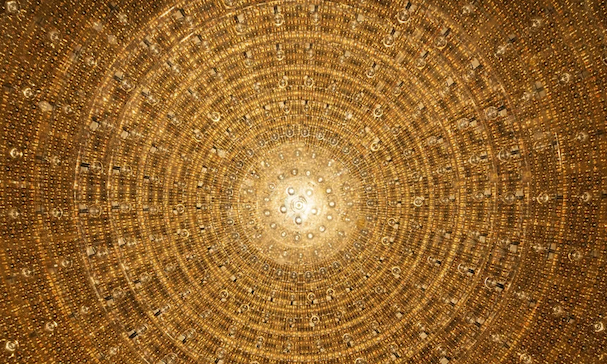
December 1, 2025—The moments before insight are often unpredictable. Plus, cats had a slow and complicated domestication, and the WHO releases global guidelines for weight-loss drugs. —Andrea Gawrylewski, Chief Newsletter Editor | | JUNO's central detector is filled with scintillating fluid and surrounded by photomultiplier tubes. Yuexiang Liu/JUNO Collaboration | | A mathematician's movements at a chalkboard may signal their next mathematical breakthrough. Researchers recorded six mathematicians at chalkboards as they spent 40 minutes working on two math proofs and thinking aloud. Every time they shifted attention to other parts of the board by writing, erasing or pointing at equations, diagrams, or other inscriptions, observers made a note. They also recorded exclamations of insight. Recordings showed that two minutes before a breakthrough, the mathematicians' behavior became less predictable. Why this is interesting: It's unclear where that unpredictability originates: Either a bubbling idea led solvers to connect puzzle pieces across the board, or solvers had grown frustrated and decided to physically forage for new connections elsewhere, which sparked a solution, writes Jacek Krywko. Perhaps it was a mixture of both. What the experts say: "I only wish [the paper] helped me figure out how to have more insights," says Santa Fe Institute physicist and mathematician Cristopher Moore, who was not involved in the study. He'd like to see the study's statistical approach combined with deep interviews "to build up a rich corpus of what mathematicians were thinking at the time." —Andrea Tamayo, Newsletter Writer | | Barisic Zaklina/Getty Images | | Two new studies reveal the complex domestication story of cats. Scientists extracted genetic samples from ancient cat bones discovered in China, dated from around 3,500 BCE to 1,800 CE. The second study analyzed nuclear DNA from cats in Europe and North Africa. What they found: The first study found that local Asian leopard cats hung around human settlements but never became domesticated; domestic cats only arrived in the region trailing after humans on the Silk Road around 1,400 CE. And in Europe and North Africa, the analysis showed a similar slow pace of domestication of cats. Yes, the animals hung around with humans, but they were still interbreeding with wildcats. Both findings suggest that cats became truly domesticated much later than thought—perhaps only 2,000 years ago. What can be done: If domesticated cats truly arose a mere two millennia ago, then they have undergone a rapid adaptation to domestic life. But more study is needed, says Leslie Lyons, a feline geneticist at the University of Missouri, who was not involved in either study. "Domestication is a process. It's not just, one day, all the cats are sitting on your lap." (If only!)
| | | | |
- "It's not normal for public health to be so partisan," writes Tom Frieden, former director of the U.S. Centers for Disease Control and Prevention, and president of the global health organization Resolve to Save Lives. Life-saving public health programs have been cut, health experts have been replaced by unqualified partisan picks and misinformation allowed to spread on government websites. "We must stop partisanship from interfering with the basic systems that keep us safe," he says. "Every year we fail to strengthen our health defenses, lives are lost and costs rise." | 4 min read
| | - Doctors are increasingly recognizing a new form of dementia. | The New York Times
- Underwater vortices beneath Antarctica's ice could be speeding how fast it's degrading. | Grist
- Pessimistic dogs are better at sniffing out cancer: a humor column inspired by a SciAm article. | The New Yorker
- A YouTuber built a huge following by tracking down alleged child predators on Roblox, an online gaming platform. Then the site banned him. | WIRED
| | Think back to a time you had a sudden burst of insight. It's a highly pleasing sensation, when all elements of a problem seem to click into clarity. Research shows that this "aha!" moment comes with a burst of high-frequency brain waves in the brain's right temporal lobe—the part of the brain that connects with many other brain regions and is associated with our ability to realize connections between concepts that may initially seem unrelated. In my experience, such revelations feel monumental, but a bit obvious in hindsight. Once the brain makes the connection it locks in place. | | —Andrea Gawrylewski, Chief Newsletter Editor
| | | | |
Subscribe to this and all of our newsletters here. | | | | |