For the infinitely curious person ͏ ͏ ͏ ͏ ͏ ͏ ͏ ͏ ͏ ͏ ͏ ͏ ͏ ͏ ͏ ͏ ͏ ͏ ͏ ͏ ͏ ͏ ͏ ͏ ͏ ͏ ͏ ͏ ͏ ͏ ͏ ͏ ͏ ͏ ͏ ͏ ͏ ͏ ͏ ͏ ͏ ͏ ͏ ͏ ͏ ͏ ͏ ͏ ͏ ͏ ͏ ͏ ͏ ͏ ͏ ͏ ͏ ͏ ͏ ͏ ͏ ͏ ͏ ͏ ͏ ͏ ͏ ͏ ͏ ͏ ͏ ͏ ͏ ͏ ͏ ͏ ͏ ͏ ͏ ͏ ͏ ͏ ͏ ͏ ͏ ͏ ͏ ͏ ͏ ͏ ͏ ͏ ͏ ͏ ͏ ͏ ͏ ͏ ͏ ͏ ͏ ͏ ͏ ͏ ͏ ͏ ͏ ͏ ͏ ͏ ͏ ͏ ͏ ͏ ͏ ͏ ͏ ͏ ͏ ͏ ͏ ͏ ͏ ͏ ͏ ͏ ͏ ͏ ͏ ͏ ͏ ͏ ͏ ͏ ͏ ͏ ͏ ͏ ͏ ͏ ͏ ͏ ͏ ͏ ͏ ͏ ͏ ͏ ͏ ͏
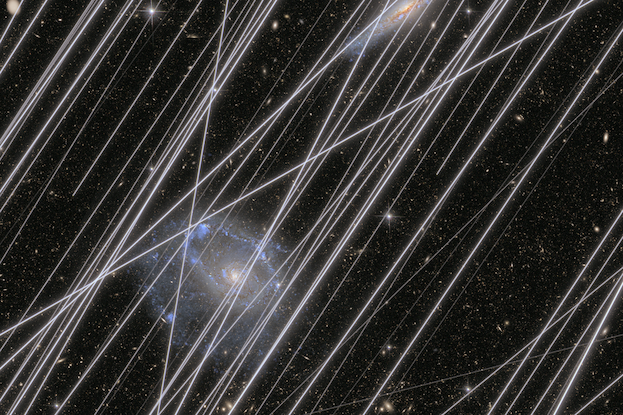
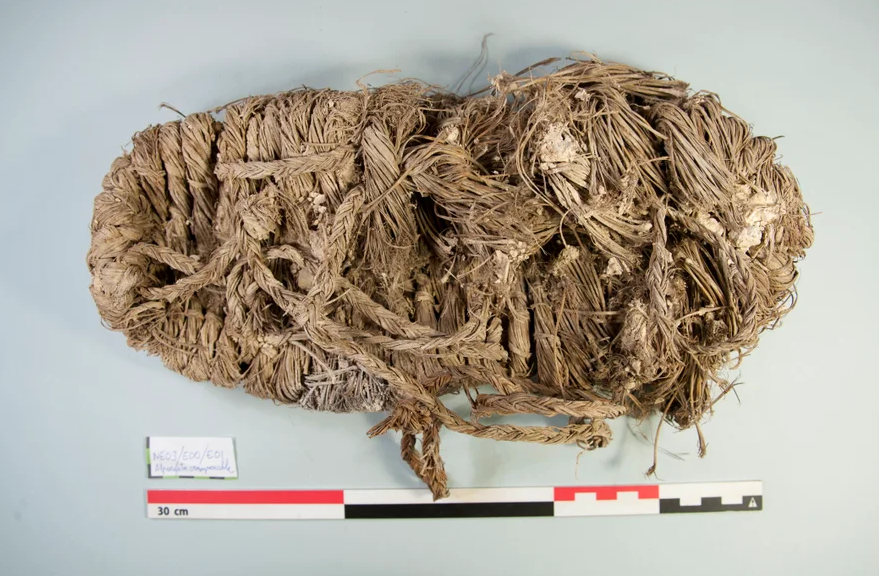
December 3, 2025—Mind-bending math underpins all reality. Plus, these vultures have scavenged human belongings for hundreds of years, and scientists find no evidence of a theoretical particle. —Andrea Gawrylewski, Chief Newsletter Editor | | A simulated image represents the projected contamination by satellite trails in telescope observations. NASA/"Satellite Megaconstellations Will Threaten Space-Based Astronomy," by Alejandro S. Borlaff et al., in Nature. Published online December 3, 2025 (CC BY-NC-SA 4.0) | | In October 2024 Luke Durant, an independent researcher in San Jose, Calif., announced that he had discovered the largest known prime number—so enormous it would take years to write out in full. One might suspect only mathematicians would celebrate such a feat. But primes are often considered the building blocks of mathematics, and math itself is the scaffolding that supports everything from quantum theory and smartphone algorithms to the stability of bridges and even the odds at a casino. This year I put together a collection of some of our most mind-bending math articles. It nearly broke my brain, but in the best way possible. | | 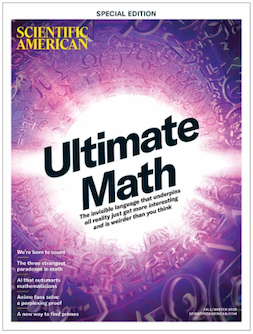 Illustration by Mark Ross What's inside: Humans are natural mathematicians, and studies have shown that babies are born with an inherent sense of numbers. For some this natural ability leads to a lifelong devotion: in 2023 precocious high school students published a proof of the Pythagorean theorem that uses trigonometry, and the winner of the 2025 Abel Prize in mathematics was Masaki Kashiwara, who has studied the field for nearly seven decades. Illustration by Mark Ross What's inside: Humans are natural mathematicians, and studies have shown that babies are born with an inherent sense of numbers. For some this natural ability leads to a lifelong devotion: in 2023 precocious high school students published a proof of the Pythagorean theorem that uses trigonometry, and the winner of the 2025 Abel Prize in mathematics was Masaki Kashiwara, who has studied the field for nearly seven decades. The hunt for prime numbers continues, including using a new method that involves integer partitions. Math, naturally, is integral to physics, cosmology and our comprehension of the universe: So-called complex numbers are a crucial element of quantum theory. And math shows up in everyday life in surprising ways. Equations govern the stability of infrastructure such as bridges and airplanes. Math even addresses the mundane problem of moving a sofa around a corner (Ross, from Friends, was right: pivot!). So what did I learn from digging into the theorems, paradoxes and equations? Mathematics is not only an esoteric vocation but also indispensably alive and deeply human. Subscribe and download the full collection or find it on newsstands. | | A shoe, more than 670 years old, was one of 25 found in the top layers of 12 vulture nesting sites. It is a design that was typically worn for a few days before being repaired or replaced. Lucia Agudo Perez | | Bearded vultures are more than carrion scavengers—they are also collectors of human ephemera. From 2008 to 2014, cliff-rappelling scientists uncovered a trove of historic human artifacts from 12 bearded vulture nests perched on the cliffside caves of southern Spain. The findings include a crossbow bolt, part of a slingshot and a piece of leather with red decorations that archaeologists say could be a "very peculiar mask." So far, they've also found 25 shoes made from woven esparto grass. Why this is interesting: The ancient relics provide the scientists with a "time capsule" of human activity that stretches back more than 600 years. Low humidity and protection from elements make these cliffs the perfect setting to preserve traces of human history and past environmental conditions. What the experts say: These findings are just the beginning, says study co-author Ana Marín-Arroyo, a prehistory professor at the University of Cantabria. "If the upper layers are from the 13th century, the lower layers are going to be older." —Andrea Tamayo, Newsletter Writer
| | | | |
- Economists tally up the annual cost of climate change on U.S. families. And it's steep. | Heatmap
- Scientific research relies on statistical significance to draw conclusions. But is the practice leading science astray? | Reason
- Does smoking pot help people drink less alcohol? Scientists are looking into it. | NPR
| | Articles on math are some of the most popular we publish, which to me feels like proof that numbers aren't cold, but magnetic. Last year physicists used principles of information entropy (a mathematical measure of how surprising information is) and discovered that the music of Johann Sebastian Bach contains mathematical patterns that help convey information. And that, to me, is the thrill of math—it's the hidden architecture that gives meaning to music. | | Are you a math lover? Let me know and send other newsletter feedback to: newsletters@sciam.com. Until tomorrow. —Andrea Gawrylewski, Chief Newsletter Editor
| | | | |
Subscribe to this and all of our newsletters here. | | | | |